Cloudy Hot Tub Water: Every Cause and How to Fix It
Cloudy water has over ten possible causes. Use this diagnostic guide to find yours fast, with exact PPM ranges and step-by-step fixes.
You tested the water, the numbers looked close enough, and then you pulled back the cover to find the water looking like someone poured milk into it. Cloudy hot tub water is the single most common complaint from hot tub owners. It’s also one of the most misdiagnosed.
The standard advice online is to dump in clarifier and hope for the best. That’s treating a symptom. Cloudiness is a signal, and finding the actual cause takes about five minutes of testing. Here’s how to diagnose yours and fix it for real.
Start here: the five minute diagnosis
Before buying products or changing anything, run through this sequence. It catches the cause roughly 90% of the time.
- Test your sanitizer. Free chlorine should read 3 to 5 ppm. Bromine should read 3 to 5 ppm. If either is below 1 ppm, that’s almost certainly your problem. Low sanitizer causes more cloudiness than everything else on this list combined.
- Test pH and total alkalinity. pH should be 7.4 to 7.6. Total alkalinity should be 80 to 120 ppm. If pH is above 7.8, dissolved minerals start precipitating out of solution and hazing the water.
- Do the glass test. Fill a clear glass with tub water and set it on the counter. If the cloudiness clears from the bottom up within a few minutes, you’re looking at tiny air bubbles, not a chemistry problem. No treatment needed.
- Look at the filter. Pull it out. If it’s caked with debris, slimy, or hasn’t been cleaned in a month, that’s your bottleneck. A dirty filter can’t remove the fine particles causing the haze.
- Test calcium hardness. If the above checks out, test calcium. Above 300 ppm, especially combined with high pH, calcium precipitates and turns the water chalky white.
If you’ve gone through all five and the water is still cloudy, keep reading. But most people find their answer in steps one through three.
Low sanitizer
The number one cause by a wide margin.
Free chlorine below 1 ppm or bromine below 2 ppm means bacteria and organic contaminants are multiplying unchecked. Their waste products create suspended particles that scatter light and make the water hazy. Sometimes the water looks almost gray. Sometimes milky. Either way, the fix is the same.
Shock the tub with dichlor granules. For a 300 to 400 gallon tub, 2 tablespoons gets you to roughly 10 ppm free chlorine. Run the jets and filter continuously until the water clears, usually 6 to 12 hours. Then figure out why your sanitizer dropped in the first place. Heavy bather load? Missed a few doses? High CYA making your chlorine less effective?
If chlorine disappears within hours of adding it (high chlorine demand), the water may have an organic load too heavy for normal dosing. A drain and refill is faster and more effective than fighting through it with chemicals.
High pH
When pH climbs above 7.8, two things happen at once. Dissolved minerals, especially calcium, begin precipitating out of the water and creating a visible haze. And your sanitizer’s effectiveness drops sharply. At pH 8.0, chlorine is only about 22% active. So you get mineral cloudiness AND reduced bacteria killing at the same time.
Add pH decreaser (sodium bisulfate) in small increments. One tablespoon per 200 gallons, circulate for 20 minutes, retest. Don’t try to drop the pH in one big dose. Overshooting creates the opposite problem.
If pH keeps drifting up despite corrections, your total alkalinity is probably too high and buffering the pH upward. Fix alkalinity first (see next section), then pH will behave.
High total alkalinity
Total alkalinity above 150 ppm acts as a pH anchor, making pH resist downward adjustment and drift upward on its own. That rising pH then causes the mineral precipitation described above. Cloudiness from high TA usually looks uniformly milky rather than greenish or gray.
Correcting high TA takes patience. Add sodium bisulfate (same product as pH decreaser) to lower TA. Then aerate the water: run the jets with air valves open and the cover off. Aeration raises pH without raising TA, so you can keep lowering TA with acid while letting pH recover naturally through aeration. Repeat the cycle until TA lands between 80 and 120 ppm.
Fixing TA is the most tedious water chemistry correction in hot tub ownership. Nobody enjoys it. But once TA is in range, pH stops fighting you.
High calcium hardness
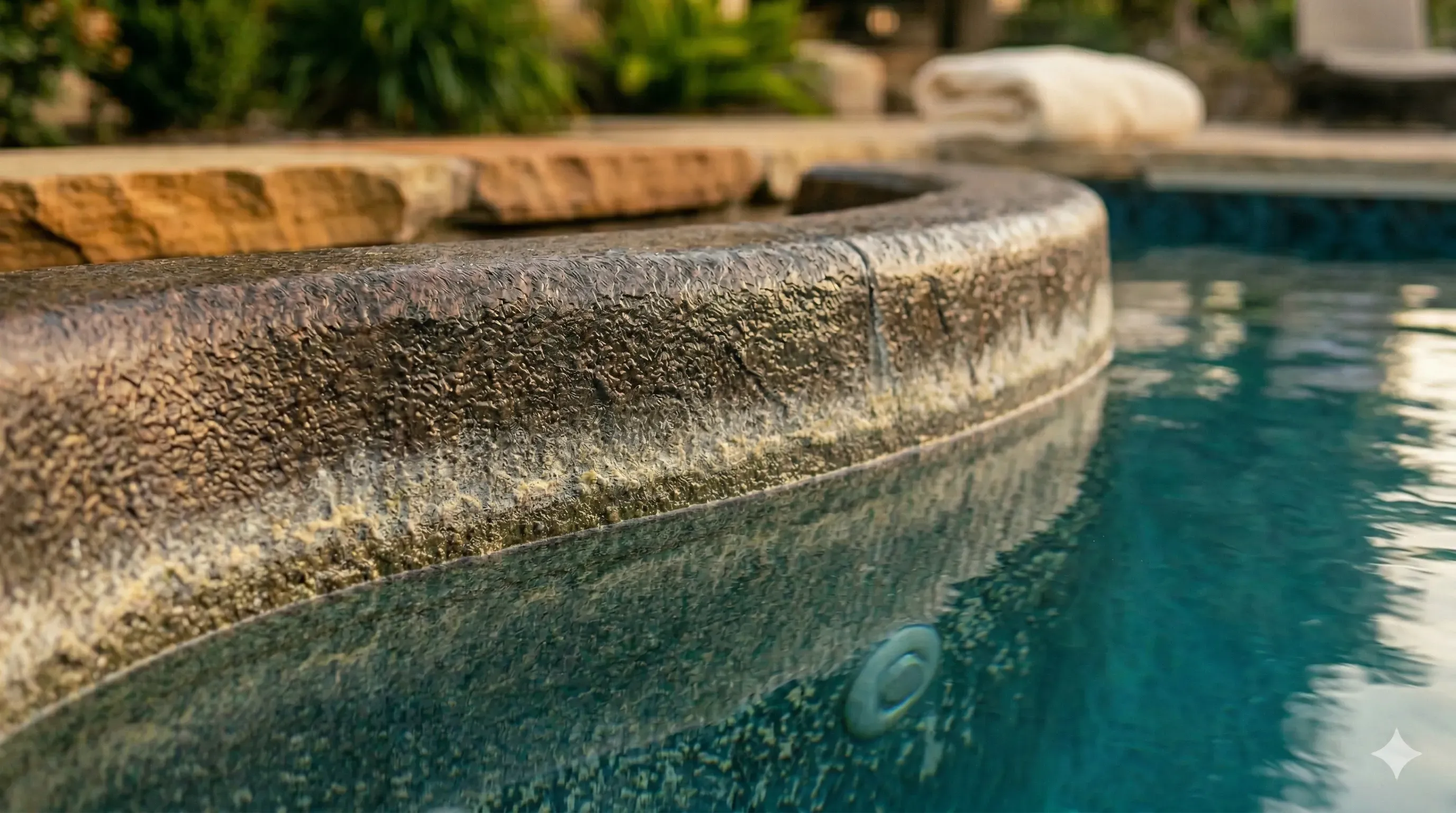
Calcium hardness above 300 ppm, especially when pH and alkalinity are also elevated, causes a white chalky haze in the water. You might also see white flakes or scale deposits on the shell, along the waterline, and crusted around the jets.
And the frustrating part? no chemical lowers calcium hardness. Your only option is dilution. Drain half the water and refill with softer water. If your tap water is the source of the high calcium (common in the Southwest and Midwest), use a hose pre-filter when refilling.
Going forward, keep pH and alkalinity at the lower end of their ideal ranges. Lower pH and TA reduce the chance that calcium precipitates even when the hardness level is on the higher side.
Biofilm
If the water clears after shocking but turns cloudy again within a day or two, biofilm is the likely culprit. Biofilm is a structured colony of bacteria living inside your plumbing, protected by a polysaccharide slime layer that resists normal sanitizer levels. You can shock the open water all day and the biofilm in the pipes survives.
You’ll recognize it by the pattern: water keeps cycling between clear and cloudy no matter what you do. Sometimes you’ll see white or brown flakes shoot out of the jets when they first turn on. Those are biofilm fragments.
More chemicals in the existing water won’t solve it. Use a pipe flush product (Ahh-Some is the gold standard, about 1 tablespoon per 250 gallons) with the jets on high for 20 to 30 minutes. You’ll see foam and sometimes alarming quantities of gunk rise to the surface. Then drain completely, wipe the shell clean, refill, and rebalance from scratch.
Ask anyone on a hot tub forum and they’ll tell you the same thing: they wish they’d done the pipe flush weeks earlier instead of fighting with shock and clarifier.
Dirty or spent filter
Your filter catches suspended particles that cause haze. When it’s clogged with debris or the filter media is worn out, fine particles pass right through and the water stays cloudy no matter how balanced the chemistry is.
Clean the filter by removing it and rinsing thoroughly with a garden hose. For a deeper clean, soak overnight in a filter cleaning solution, then rinse. Replace filters entirely every 12 to 18 months even with regular cleaning, because the pores in the fabric stretch and lose their ability to trap fine particles.
A lot of experienced owners keep two filter cartridges and rotate them. While one is soaking and drying, the other is working. This also extends the total lifespan of both filters.
Body oils, lotions, and cosmetics
Every person who soaks brings organic contaminants. Deodorant, sunscreen, hair products, body lotion, and laundry detergent residue on swimsuits all dissolve into the water. In a 300 gallon tub, the concentration builds fast. The water develops an oily haze, sometimes with foam on the surface and a scum ring at the waterline.
Shock weekly to oxidize the organic load. Use enzyme-based products (Spa Marvel or Natural Chemistry Spa Perfect) to break down oils between shocks. Floating oil-absorbing sponges placed in the water help too.
The bigger fix is behavioral. Shower before soaking. Rinse swimsuits in plain water between uses instead of washing them with detergent. These two habits alone cut the organic load in half.
Air bubbles (not actually a chemistry problem)
Brand new water after a refill sometimes looks milky or fizzy. Tiny air bubbles trapped in the water scatter light and mimic the appearance of chemical cloudiness. The glass test catches this: fill a clear glass from the tub, set it down, and watch. If the haze clears from the bottom up within a few minutes, it’s air.
This usually resolves itself within 30 to 60 minutes of running the jets. If it persists, check for a loose pump connection or a suction-side air leak drawing air into the plumbing. Also make sure the air injection valves on your jets aren’t wide open.
You don’t need chemicals or treatment. Just patience, and maybe tightening a connection.
High total dissolved solids
Every chemical you add, every bather who soaks, every top-off after evaporation pushes TDS higher. Past 1,500 ppm above your starting fill water, the water looks dull, chemicals stop cooperating, and a stubborn haze sets in. No chemical fixes this. Drain and refill.
Cloudiness after a refill
Sometimes fresh fill water turns cloudy within hours. This is usually minerals in the tap water reacting to the temperature change, or aggressive water (low calcium, low pH) pulling metals from your plumbing as it heats up.
If the water has a brownish or greenish tint after heating, metals are likely the cause. Iron shows up as brown or rust colored. Copper turns water green or teal. A metal sequestrant binds the dissolved metals and lets your filter trap them.
If the water is white or milky, test calcium hardness. Some tap water arrives at 250+ ppm, which can precipitate immediately in hot tub temperatures.
Prevent this by testing your fill water before adding chemicals. Balance alkalinity first, then pH, then calcium, then add sanitizer. Give each chemical 20 minutes of circulation before adding the next.
Why does cloudy water keep coming back?
Recurring cloudiness is a different animal than a one-time event. If you keep shocking and the water keeps hazing over, stop reaching for more product and start looking at root causes.
Biofilm is the usual suspect. The pattern gives it away: shock, water clears, cloudy again within 24 to 48 hours. The biofilm inside your plumbing keeps releasing bacteria and waste into the water faster than you can treat it. Only a pipe flush and drain breaks the loop.
Inconsistent sanitizer is the second. Some owners only test and dose when they soak, leaving the water unprotected between sessions. Bacteria don’t take days off. Maintain 3 to 5 ppm free chlorine around the clock, including days nobody uses the tub.
Old water is the third. If you haven’t drained in four or five months and the water just won’t cooperate despite balanced chemistry, the water itself is worn out. Total dissolved solids have accumulated past the point where chemicals can keep up. Drain it. Fresh water resets everything.
And sometimes it’s the filter. A cartridge that’s been “cleaned” for 18 months without replacement loses its ability to catch fine particles. The water looks hazy even when chemistry is spot-on because the filter is just pushing particles in circles.
Is it safe to soak in cloudy water?
No. With one exception.
If the cloudiness is from air bubbles after a refill (confirmed by the glass test), the water is fine. It’s just air.
For every other cause, cloudy water means something is wrong. Maybe your sanitizer has bottomed out and bacteria are running unchecked. Maybe your pH has drifted high enough that chlorine is barely functional even though the test strip looks OK. Or maybe biofilm in the plumbing is pumping contaminants into the water every time the jets kick on.
Don’t get in until you’ve diagnosed the cause and the water is clear again. A few hours of troubleshooting beats a week of skin irritation or worse.
Frequently asked questions
How do I fix cloudy hot tub water fast? Test sanitizer first. If free chlorine is below 3 ppm, shock with dichlor and run the filter continuously. Most sanitizer-related cloudiness clears within 6 to 12 hours. If sanitizer is fine, check pH and alkalinity next. Targeted fixes based on your actual test results work much faster than adding clarifier without knowing the cause.
Is it safe to get in a cloudy hot tub? Only if you’ve confirmed the cloudiness is air bubbles (the glass test: fill a glass, set it down, watch it clear from the bottom). Chemical cloudiness means something in your water isn’t right, and getting in without knowing the cause isn’t worth the risk. Bacterial cloudiness can cause skin infections and respiratory irritation.
Why is my hot tub still cloudy after shocking? Two likely causes. First, the cloudiness isn’t from organic waste or low sanitizer. Shock can’t fix high calcium, high TDS, or a clogged filter. Second, biofilm in the plumbing is continuously recontaminating the water. If shocking clears it briefly before it returns, biofilm is almost certainly the culprit. A pipe flush and drain is the real fix.
How long does it take for cloudy hot tub water to clear? Low sanitizer cloudiness: 6 to 12 hours after shocking with the filter running. Air bubbles: 30 to 60 minutes. High pH or alkalinity: a few hours after correction. High calcium hardness or TDS: these won’t clear with chemicals and require a partial or full water change. Biofilm: won’t clear until you flush the plumbing and start over.
Can too much chlorine make a hot tub cloudy? No. But a heavy shock can oxidize dissolved metals (iron, copper) and turn the water hazy. If cloudiness appeared right after shocking, a sequestering agent and clean filter will clear it.
Why does my hot tub get cloudy after every use? Body oils, cosmetics, and detergent residue from swimsuits. Every bather adds organic load that your sanitizer has to fight through. In 300 gallons, it builds up fast. Shower before soaking, rinse suits in plain water instead of washing them with detergent, and shock weekly to oxidize what accumulates. If you’re doing all of that and the water still hazes after each session, your filter is the next thing to look at. It might be overdue for a deep clean or a full replacement.