Dichlor vs Trichlor: Which Chlorine for Your Hot Tub?
They're both chlorine, but one belongs in your hot tub and the other will damage your equipment and wreck your water chemistry.
Walk into any pool store and you’ll find shelves lined with chlorine products. Tablets, granules, pucks, sticks. They all say “chlorine” on the label. Grabbing one at random seems harmless. It’s not. In a hot tub, the type of chlorine matters a lot. Dichlor and trichlor are both stabilized chlorine, but one belongs in your spa and the other will quietly wreck it.
This isn’t a minor distinction. Using trichlor in a hot tub can corrode your heater, etch your shell, bleach your cover, and make your water chemistry nearly impossible to manage. Here’s the full breakdown of why, with the actual chemistry behind it.
Quick comparison
| Dichlor | Trichlor | |
|---|---|---|
| Chemical name | Sodium dichloro-s-triazinetrione | Trichloroisocyanuric acid |
| Form | Fast dissolving granules | Slow dissolving tablets/pucks |
| Available chlorine | 56% to 62% | 90% |
| pH | 6.5 to 7.0 (near neutral) | 2.8 to 3.0 (extremely acidic) |
| CYA added per 10 ppm chlorine | ~9 ppm | ~6 ppm |
| Dissolves in | 1 to 3 minutes in warm water | Days in pool temp, hours in hot tub temp |
| Safe for hot tubs? | Yes (with CYA management) | No |
What each one actually is
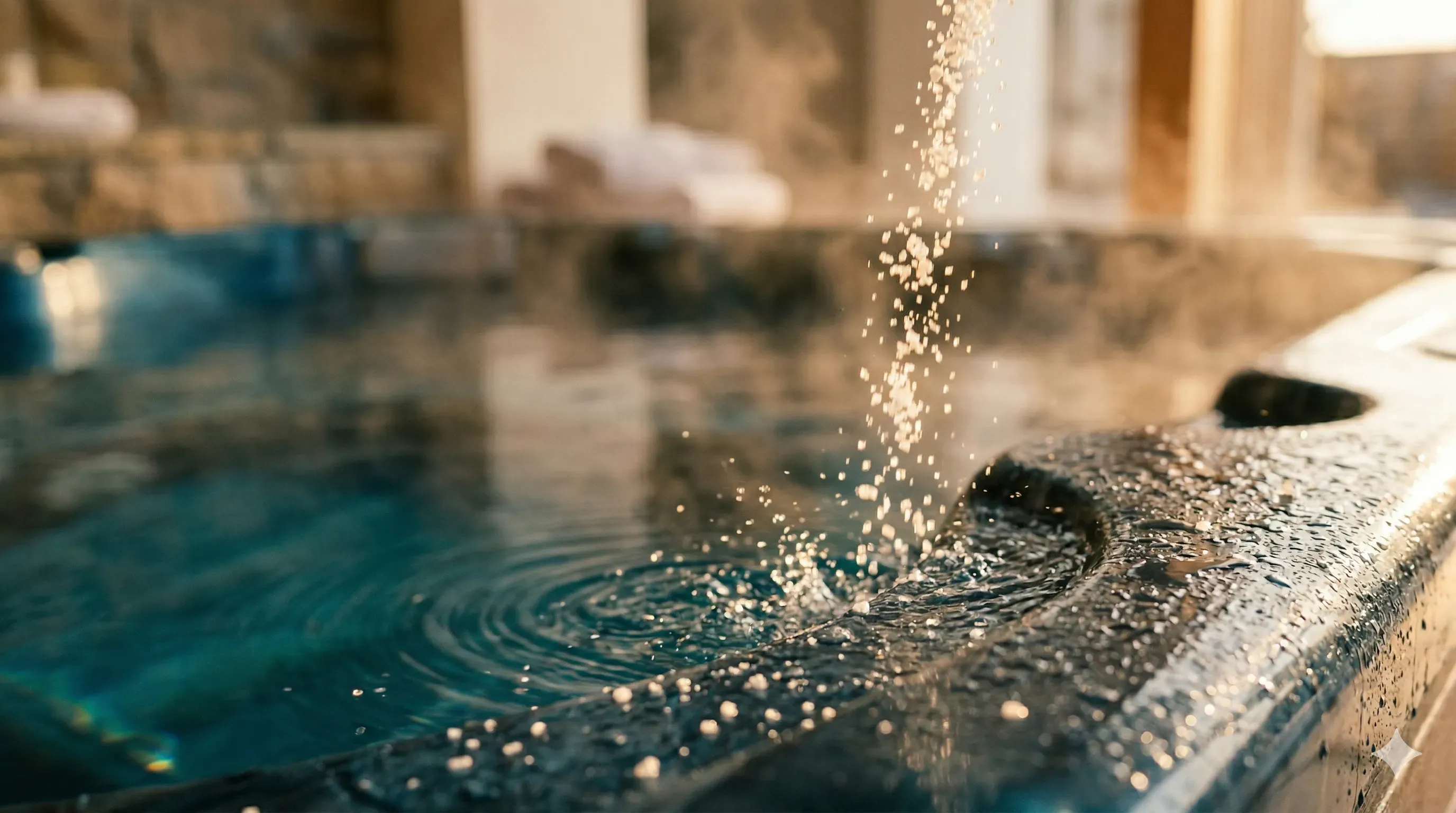
Dichlor is short for sodium dichloro-s-triazinetrione. It’s a granular chlorine with about 56% to 62% available chlorine. You sprinkle it over the water surface with the jets running and it dissolves in one to three minutes. Its pH is close to neutral (around 6.5 to 7.0), so it barely moves your water’s pH when you add it. This is a big deal in a small body of water like a hot tub, where every chemical addition has an outsized impact.
Trichlor is trichloroisocyanuric acid. It has a higher available chlorine content (about 90%) and usually comes as slow dissolving tablets or pucks. Its pH sits between 2.8 and 3.0, making it extremely acidic. In a swimming pool with 15,000 or 20,000 gallons of water, that acidity gets diluted into insignificance. A single trichlor tablet in 20,000 gallons barely moves the pH needle.
In a hot tub with 300 to 400 gallons, that same tablet is 50 times more concentrated. The impact is massive.
Why trichlor damages hot tubs
Trichlor causes problems in a hot tub on multiple fronts, and any single one of them is enough to do serious damage.
The acidity problem
A trichlor tablet has a pH of about 2.8. For reference, lemon juice is around 2.0 and vinegar is around 2.4. You wouldn’t pour vinegar into your hot tub, but a trichlor tablet creates similar localized acidity wherever it sits or dissolves.
That concentrated acid pocket does real damage. It etches acrylic shells, leaving dull spots or white marks on the surface. It corrodes metal heater elements and fittings (copper and stainless steel both react to sustained low pH). It degrades rubber gaskets and O-rings in pumps and unions. And if a tablet sits in a floater that drifts against the cover, it bleaches and deteriorates the vinyl underside.
The damage happens slowly, which makes it worse. You might use trichlor for six months and not notice anything. Then your heater element fails or a pump seal starts leaking. The cause was slow acid corrosion, not a sudden failure.
The dissolution rate problem
Trichlor tablets are designed to dissolve slowly in 75°F to 82°F pool water, releasing chlorine over five to seven days. Hot tub water sits at 100°F or higher. At that temperature, the tablets dissolve much faster than intended.
Instead of a slow, steady release of chlorine, you get unpredictable spikes. Your chlorine might read 1 ppm in the morning and 12 ppm by the afternoon when the tablet has been dissolving in warm water all day. That kind of swing makes consistent sanitation impossible. High chlorine spikes bleach swimsuits, irritate skin and eyes, and damage covers. Low chlorine windows leave the water unprotected.
Dichlor doesn’t have this problem because it dissolves in minutes. You add it, it’s immediately and evenly distributed, and you know exactly what your chlorine level is within five minutes of adding it.
The CYA accumulation problem
This is the one that matters most long term. Both dichlor and trichlor contain cyanuric acid (CYA), a stabilizer that shields chlorine from UV degradation. In an outdoor pool or hot tub exposed to direct sunlight all day, CYA is essential. It prevents the sun from burning off your chlorine within hours.
In a covered hot tub that gets minimal UV exposure, CYA is unnecessary. And here’s the problem: CYA doesn’t evaporate, break down, or get filtered out. Every single dose of dichlor or trichlor adds more CYA to the water, and the only way to remove it is to drain and refill.
The math on CYA accumulation is sobering. For every 10 ppm of chlorine you add via dichlor, you also add about 9 ppm of CYA. In a 300 gallon hot tub where you’re adding 1.5 teaspoons of dichlor four times a week, your CYA reaches 50 ppm in about four weeks and 100 ppm in about seven weeks.
That matters because CYA slows down chlorine’s killing speed. According to research published in AQUA Magazine, the kill time for Pseudomonas aeruginosa (the bacterium behind hot tub rash) with zero CYA is about 20 seconds. At 50 ppm CYA, kill time increases to 1 minute 30 seconds. At 100 ppm CYA, it’s nearly 2 minutes. That might not sound like much, but in a hot tub where bathers are constantly introducing new contamination, those extra minutes mean chlorine can’t keep up.
The result: cloudy water, the strong “chemical” smell (which actually signals combined chlorine, not free chlorine), skin irritation, and recurring hot tub rash. People add more chlorine thinking the problem is too little sanitizer, but the real problem is CYA blocking the chlorine from doing its job.
The CDC recommends against using CYA or CYA containing chlorine products in hot tubs and spas. Despite this, dichlor remains the most popular hot tub chlorine because there aren’t many practical CYA free alternatives for residential users.
So why does anyone use dichlor?
Because it’s the least bad option for most people. (If you’re open to alternatives, bromine is worth considering — it adds zero CYA.) Dichlor’s near neutral pH means it doesn’t cause the acid damage that trichlor does. Its fast dissolution means even distribution and predictable dosing. And its CYA contribution is manageable if you drain and refill on schedule (every three to four months) and don’t overdose.
The key is dosing correctly. For a 300 to 400 gallon tub, maintenance dosing is about 1/4 to 1/2 teaspoon per 100 gallons, depending on bather load. That works out to roughly 3/4 to 1.5 teaspoons for a typical tub. Add it after each soak rather than on a fixed schedule, and always test before and after to find the dose that brings you to 3 to 5 ppm free chlorine.
Don’t use a chlorine floater with dichlor tablets. Dichlor granules dissolve fast enough that a floater is unnecessary, and floating dispensers create concentrated hot spots near the waterline where they rest against the shell or cover.
The dichlor then bleach method (for CYA control)
If you spend any time on hot tub forums, you’ll hear about this approach. It’s one of the best ways to use chlorine in a hot tub while keeping CYA under control. We have a complete step-by-step guide to the dichlor bleach method with dosing charts, but here’s the overview.
Here’s how it works step by step:
Week 1 to 2 after a fresh fill: Use dichlor granules for your regular chlorine additions. This intentionally builds a small CYA base of 20 to 30 ppm. Some CYA is actually helpful in this range because it slightly stabilizes the chlorine and prevents it from being consumed too fast by UV if you soak with the cover off.
Week 3 onward: Switch to plain unscented liquid bleach (sodium hypochlorite, 8.25% concentration). Bleach adds zero CYA. This keeps your stabilizer level flat for the rest of the water’s life.
Bleach dosing for a hot tub: About 2 to 3 tablespoons of 8.25% bleach per 300 gallons raises free chlorine by roughly 3 to 5 ppm. Start with 2 tablespoons, test after 15 minutes, add more if needed. Bleach is available at any grocery store. Make sure it’s unscented with no additives. The label should say “sodium hypochlorite 8.25%” and nothing else.
Important: Bleach has a high pH (around 12.5), so you’ll need to adjust pH down after adding it. This isn’t as annoying as it sounds because dichlor’s near neutral pH would have been slowly letting your pH creep up anyway. Most hot tub owners need to add pH decreaser regularly regardless of their chlorine source.
This method requires more frequent testing than a set it and forget it dichlor routine. But it keeps CYA under control and produces better water quality over a three to four month fill cycle.
What about cal-hypo?
Calcium hypochlorite (cal-hypo) is another chlorine type you’ll see at pool stores. It contains zero CYA, which makes it sound ideal for hot tubs. But it has two problems:
First, its pH is around 11.0, so it pushes your water strongly alkaline with every dose. In the small volume of a hot tub, this means constant pH correction.
Second, it adds calcium to the water with every dose. In a hot tub, calcium accumulates just like CYA does. If your fill water already has moderate calcium (150+ ppm), regular cal-hypo use can push calcium hardness into scale territory (above 300 ppm) within a few weeks. Scale clogs jets, insulates heaters, and creates white crusty deposits on every surface.
Cal-hypo works in pools because the large water volume dilutes both the pH and calcium impacts. In a hot tub, it causes as many problems as it solves.
How to tell what you’re buying
Flip the container over and read the active ingredient. Don’t trust the front label.
Sodium dichloro-s-triazinetrione means dichlor. Good. This is what you want.
Trichloro-s-triazinetrione or trichloroisocyanuric acid means trichlor. Put it back. It doesn’t matter if the label says “for pools and spas.” The trichlor inside is only safe for pools.
Calcium hypochlorite means cal-hypo. Not recommended for regular hot tub use (see above), but acceptable for occasional shock treatments if you monitor calcium levels.
Sodium hypochlorite means liquid chlorine or bleach. Safe for hot tubs. Just manage the pH impact.
If you’re currently using trichlor tablets in your hot tub, the fix is straightforward: drain and refill to reset your CYA level (here’s our full restart guide), then switch to dichlor granules or the dichlor/bleach method. There’s no chemical way to lower CYA in existing water. Dilution through partial drain/refill or a full water change is the only option.
Frequently asked questions
Can I use pool chlorine tablets in my hot tub? No. Most pool chlorine tablets are trichlor with a pH of 2.8 to 3.0. In the small water volume of a hot tub (300 to 400 gallons), that concentrated acidity corrodes fittings, etches the shell, degrades rubber seals, and makes water balance nearly impossible. Always use dichlor granules.
What type of chlorine is best for hot tubs? Dichlor granules (sodium dichloro-s-triazinetrione) for most people. Near neutral pH, dissolves in minutes, easy to dose. For advanced users, the dichlor then bleach method offers better CYA control.
How fast does CYA build up from dichlor? In a 300 gallon tub dosed with 1.5 teaspoons of dichlor four times per week, CYA reaches about 50 ppm in four weeks and 100 ppm in seven weeks. At 50+ ppm, chlorine’s ability to kill bacteria is measurably reduced. This is why draining every three to four months matters.
What does CYA do in a hot tub? Cyanuric acid shields chlorine from UV breakdown. Useful in sunlit pools, unnecessary in covered hot tubs. As CYA builds up, it slows chlorine’s kill time against bacteria like Pseudomonas. The CDC recommends against CYA in hot tubs. If you use dichlor, keep CYA below 30 to 40 ppm by draining on schedule.
What is the dichlor/bleach method? Use dichlor for the first one to two weeks after a fresh fill to build 20 to 30 ppm CYA, then switch to unscented 8.25% liquid bleach (about 2 to 3 tablespoons per 300 gallons per dose). Bleach adds zero CYA, so your stabilizer level stays flat. It requires more frequent testing but avoids CYA buildup entirely.
What happens if I’ve been using trichlor in my hot tub for months? Your CYA level is likely 100+ ppm, which means your chlorine isn’t killing bacteria fast enough even if test strips show normal free chlorine levels. Drain the tub completely, refill with fresh water, and switch to dichlor granules. No chemical can remove CYA from existing water.
Can I use cal-hypo (calcium hypochlorite) in my hot tub instead? Occasionally for shock treatments, but not for daily sanitation. Cal-hypo’s pH of 11.0 and calcium contribution create their own problems in the small water volume of a hot tub. You’d constantly fight rising pH and calcium scale.