Do You Need a Hose Filter for Your Hot Tub?
Test your water before buying a pre-filter. When you actually need one, when you don't, and what to do after filling your hot tub.
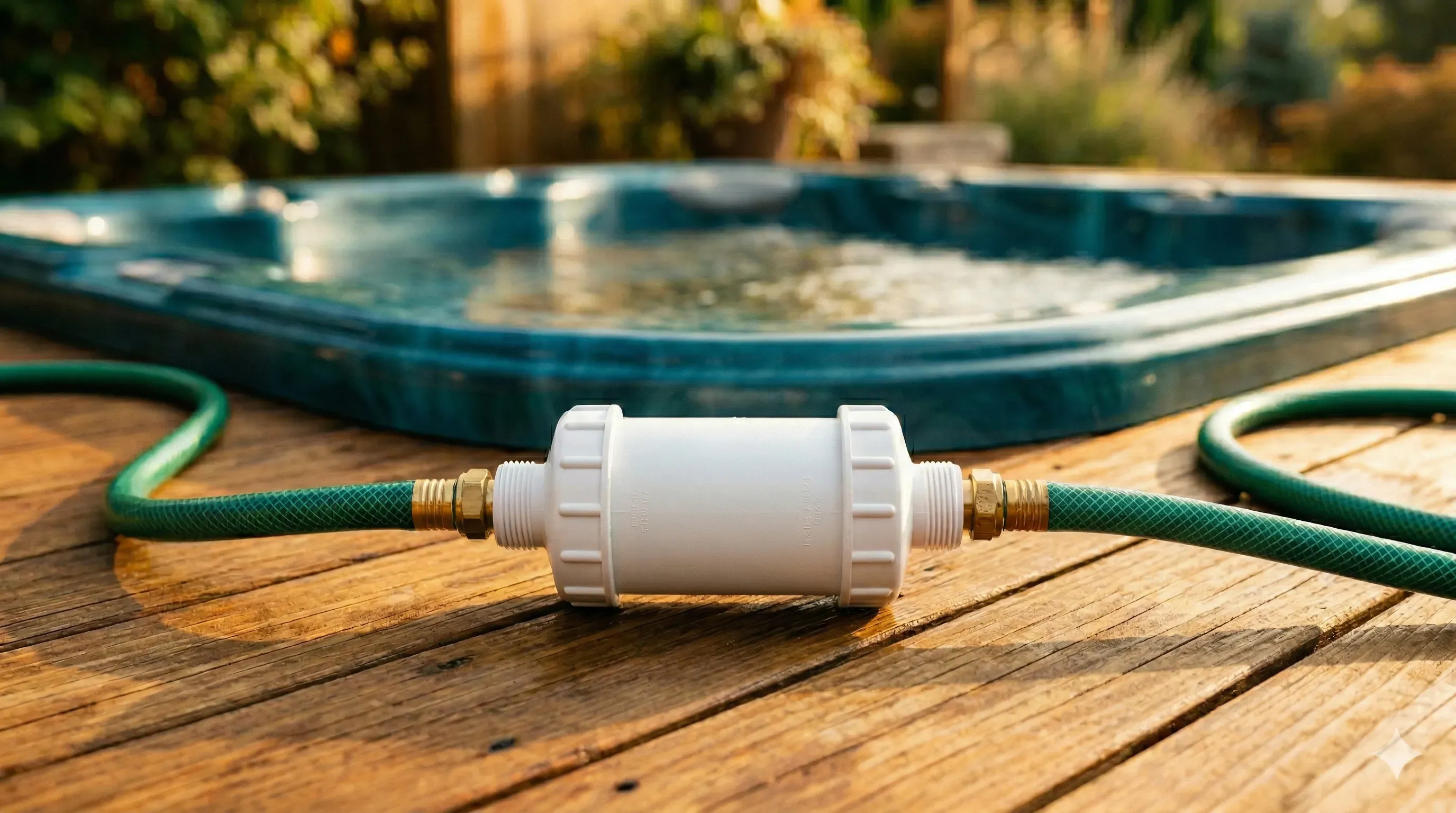
Every hot tub dealer will tell you to buy a hose filter. They sell them, so of course they recommend them. The real answer depends on what’s actually in your water, and most people have never tested it.
Some source water needs filtering. Some doesn’t. The difference between the two is a ten-dollar test strip and five minutes of your time.
What hose filters actually remove
A quality pre-filter uses multiple media types, each targeting different contaminants.
Activated carbon (usually coconut shell) removes chlorine (up to 99%), chloramine byproducts, volatile organic compounds, taste, and odor. It works through adsorption: contaminants stick to the carbon’s massive internal surface area (a single gram of activated carbon has the surface area of a football field). Carbon does not remove dissolved metals well.
KDF media (copper-zinc alloy) removes heavy metals including iron, copper, lead, mercury, and manganese through an electrochemical redox reaction. The zinc gives up electrons that convert metal ions into harmless forms. KDF also prevents bacterial growth inside the filter itself, which carbon alone cannot do.
Sediment pads (usually 5 to 20 micron) physically trap sand, dirt, rust particles, and organic debris.
The best pre-filters combine all three in a multi-stage cartridge. Carbon handles chlorine and organics. KDF handles metals. Sediment pads catch particulates.
What they don’t remove
Knowing the limitations matters just as much.
Dissolved ferrous iron. The big gotcha. Ferrous iron (Fe2+) is invisible in water and too small for mechanical filtration. A pre-filter catches oxidized ferric iron (the rust-colored particles) but dissolved iron passes right through. You won’t know it’s there until you add chlorine, which oxidizes it into visible orange-brown precipitates. KDF media helps with some dissolved iron, but very high levels (above 1 to 2 ppm) overwhelm most consumer filters.
Total dissolved solids (TDS). Filters don’t do much to reduce overall mineral content at the molecular level.
Extreme calcium hardness. If your source water is 400+ ppm, a pre-filter will reduce it somewhat but won’t bring it into the ideal 150 to 250 ppm range on its own.
Bacteria and pathogens. Pre-filters are not sanitizers. Your hot tub chemicals handle this.
Test your water first
Before spending money on a filter, find out what’s in your water.
Quick at-home testing: Heavy metals test strips are available for under 20 dollars (100 strips) and test for iron, copper, lead, mercury, and other metals in under a minute. Standard hot tub test strips measure pH, alkalinity, and calcium hardness but usually don’t test for metals.
Free option: Request your local water utility’s annual Consumer Confidence Report. Every municipal system publishes one. It lists tested contaminant levels for your service area.
Lab testing: For well water or detailed analysis, a Tap Score Metals and Minerals test provides certified lab results with specific ppm readings.
| Contaminant | Concern Threshold | What Happens in a Hot Tub |
|---|---|---|
| Iron | Above 0.3 ppm | Brown, orange, or rust-colored staining when chlorine is added |
| Copper | Above 0.2 ppm | Green or blue staining, green-tinted water |
| Manganese | Above 0.03 ppm | Pink, purple, or black water and stains |
| Calcium | Above 250 ppm | Scale on heater, jets, plumbing, and shell |
When you absolutely need one
Well water. Non-negotiable. Well water commonly contains elevated iron, copper, manganese, and sediment that vary by local geology. Midwest and Southwest regions (limestone geology) tend toward high calcium and iron. Even homes with whole-house iron filters and water softeners report enough metals getting through to cause hot tub problems.
Source water with iron above 0.3 ppm. This is the EPA secondary standard, and it’s also the threshold where hot tub staining begins. Your water can legally contain this much and still comply with drinking water regulations.
Source water with copper above 0.2 ppm. Copper causes green staining that’s extremely difficult to remove from acrylic surfaces.
Homes with old plumbing. Aging copper and galvanized pipes leach metals into the water, especially when running hot water through them. If your home was built before 1990, the plumbing itself may be your contamination source.
Any water that looks or smells off. Cloudiness, color, or sulfur odor from the hose means filtration is essential.
When you can probably skip it
Treated city water with normal parameters. If your utility report shows iron and copper below detection limits and calcium hardness is below 200 ppm, the pre-filter provides minimal visible benefit. The chlorine in city water gets handled by your hot tub startup chemicals anyway.
Homes with a whole-house water treatment system. If you already have a water softener and carbon filter on your main supply, the water from your outdoor hose is already treated.
New copper plumbing in good condition. Less likely to leach metals.
That said, even for clean city water, a mid-range filter costs the equivalent of a few dollars per fill and lasts years. Many owners consider it cheap insurance.
Picking the right filter
| Filter | Capacity | Removes Metals? | Best For |
|---|---|---|---|
| EcoOne Hose Filter | 40,000 gallons | Yes (iron, copper, lead, arsenic) | Best overall value per gallon |
| Spa Marvel X10 | 10,000 gallons | Yes (iron, mercury, aluminum) | Best spa-specific option |
| PreFresh Fill Filter | 8,000 gallons | Yes (iron, scale minerals) | Good mid-range for hard water |
| Camco TastePure | ~3 months of use | Limited (mostly chlorine) | Budget option for city water |
Avoid the Boogie Blue Plus for hot tub filling despite its impressive 45,000 gallon capacity. Its flow rate is only 0.5 gallons per minute, meaning a 400 gallon tub would take over 13 hours to fill.
For well water with high iron, pair any hose filter with a metal sequestrant like Natural Chemistry Spa METALfree added immediately after filling.
What to do after filling
The pre-filter is step one. What you do next matters just as much.
1. Test the filled water immediately. Check pH, alkalinity, calcium hardness, and metals. This tells you what the filter removed and what got through.
2. Add sequestrant before sanitizer. Most people do this backward and pay for it. If you shock the water first, chlorine oxidizes any remaining dissolved metals instantly, creating visible precipitates and potential staining. Add a metal sequestrant (like Natural Chemistry Spa METALfree, 4 ounces per 400 gallons) while the water is still un-sanitized. Give it 15 to 30 minutes to bind to dissolved metals.
3. Then add sanitizer. Once the sequestrant has had time to work, proceed with your normal startup chemistry: adjust alkalinity first, then pH, then add sanitizer.
4. Re-dose sequestrant periodically. Sequestrants break down over time, especially in chlorinated water. Add a maintenance dose every few weeks to keep metals in solution between drain-and-refill cycles.
The pre-filter vs. sequestrant debate
Forums debate whether you need a filter, a sequestrant, or both. The answer depends on your metal levels.
Low metals (city water, below detection limits): Sequestrant alone is sufficient as insurance, or skip both entirely.
Moderate metals (iron 0.3 to 1.0 ppm): Pre-filter during fill, then add sequestrant as backup for whatever gets through. This combination handles the vast majority of situations.
High metals (iron above 1.0 ppm, usually well water): Pre-filter plus sequestrant plus a CuLator SpaPak in the skimmer basket for ongoing metal absorption. Even this combination may not fully solve the problem if iron exceeds 2 to 3 ppm, in which case whole-house filtration is the real solution.
One critical gotcha: Sequestrants keep metals dissolved (soluble). Filters catch metals that are precipitated (insoluble). These two approaches actually work against each other if used simultaneously during the fill. Use the filter during filling, then add sequestrant after the tub is full. Don’t add sequestrant to the tub while still filling through a filter.
Fill day tips
Flush the hose for 30 seconds first. Run water through the garden hose before attaching the filter. Stagnant water in the hose contains elevated metals and bacteria.
Fill through the filter compartment. Direct the hose into the skimmer or filter housing, not the open tub. This prevents air locks in the plumbing and circulation system.
Run water slowly. Slower flow through the pre-filter means better contact time with the media and more effective filtration. Don’t crank the hose to full blast.
Use cold water. Cold water dissolves less copper from household plumbing than hot water. Always fill from the cold tap or outdoor spigot.
Don’t let filtered water sit unsanitized. Carbon pre-filters remove the residual chlorine from city water, which means your freshly filled tub has zero sanitizer. Biofilm can start forming immediately. Add sanitizer as soon as the fill is complete and the water is balanced.
Frequently asked questions
Does a hose filter remove calcium hardness from water? Only partially. Hose filters with KDF media can reduce some dissolved calcium, but they won’t bring extremely hard water into the ideal range on their own. If your source water is above 400 ppm calcium hardness, a pre-filter will help but you may still need to blend with softened water or use a scale prevention product after filling.
How long does it take to fill a hot tub with a hose filter? Expect two to four hours for a 400 gallon tub, compared to 30 to 60 minutes without a filter. Most hose filters reduce flow rate to 2 to 4 gallons per minute versus 8 to 17 GPM from an unfiltered garden hose. Plan to start the fill and walk away. Slower flow actually improves filtration quality.
How many times can I reuse a hose filter? Most hose filters are disposable but rated for multiple fills. A mid-range filter rated at 8,000 to 10,000 gallons handles 20 to 25 fills of a 400 gallon hot tub, lasting five or more years at quarterly drain-and-refill intervals. There is no visible indicator when the media is exhausted, so track your total gallons filtered.
Should I use a hose filter with city water? It depends on your local water quality. City water can still contain iron up to 0.3 ppm (the EPA secondary standard) and copper from aging pipes. Test your tap water first. If metals are undetectable and calcium hardness is below 250 ppm, a pre-filter provides marginal benefit. If you have older plumbing or live in a hard water region, use one.
What is the difference between a hose filter and a metal sequestrant? A hose filter physically removes contaminants during filling. A metal sequestrant chemically binds metals already in the water to keep them dissolved so they cannot stain surfaces. Filters prevent the problem. Sequestrants manage it after the fact. For well water or high-metal sources, use both: filter during fill, then add sequestrant before sanitizer.
Why did my hot tub water turn green after filling? Green water after filling almost always means dissolved copper in your source water. The water may look perfectly clear from the hose because ferrous copper is invisible. The moment you add chlorine or bromine, it oxidizes the copper into visible green precipitates. A pre-filter with KDF media removes most copper before it enters the tub.