Hot Tub Care Guide for Beginners: Where to Start
New to hot tubs? Start here. A step-by-step walkthrough of everything you need to know, from first fill to weekly routine.

Taking care of a hot tub is simpler than most people expect. Pool stores make it sound complicated because complicated sells more products. In reality, you need a handful of chemicals, a basic testing routine, and about 15 minutes a week.
This guide walks you through everything in order. Start at the top if your tub is brand new. Jump to the maintenance section if you’re already up and running.
Step 1: Understand what your water needs
Hot tub water has four numbers you need to track:
- Free chlorine or bromine (3 to 5 ppm) — your sanitizer, the thing that kills bacteria
- pH (7.4 to 7.6) — controls how comfortable the water feels and how well your sanitizer works
- Total alkalinity (80 to 120 ppm) — buffers pH so it stays stable between adjustments
- Calcium hardness (150 to 250 ppm) — protects your equipment from corrosion or scale
That’s it. Four numbers. Everything else in hot tub care is about keeping those four in range.
Step 2: Get the right chemicals
You need five or six products and nothing else. A sanitizer (either chlorine or bromine), pH decreaser, alkalinity increaser, shock oxidizer, test strips, and calcium hardness increaser if your tap water is soft. Skip everything else the pool store tries to add to the bag. Clarifiers, enzymes, aromatherapy, and defoamer are all optional extras you can revisit later.
Step 3: Fill and balance for the first time
If your tub is new or you just drained and refilled:
- Fill through the filter housing (not directly into the shell) to push air out of the plumbing
- Heat to at least 80°F before adding any chemicals
- Test your fill water before touching anything
- Balance in order: alkalinity → pH → calcium → sanitizer → shock
The order matters. Alkalinity stabilizes pH. Balanced pH lets your sanitizer work at full strength. Skipping steps or going out of order means you’re chasing numbers in circles.
Full walkthrough with exact dosing: Hot Tub Startup After Draining
Step 4: Learn your weekly routine
Once the water is balanced, maintenance is straightforward. Here’s what an average week looks like:
Two to three times per week (2 minutes each):
- Test sanitizer, pH, and alkalinity
- Dose sanitizer if free chlorine or bromine is below 3 ppm
- Adjust pH with a small dose of pH decreaser if it’s drifted above 7.6
Once a week (10 to 15 minutes):
- Shock the tub with MPS or dichlor to break down organic waste
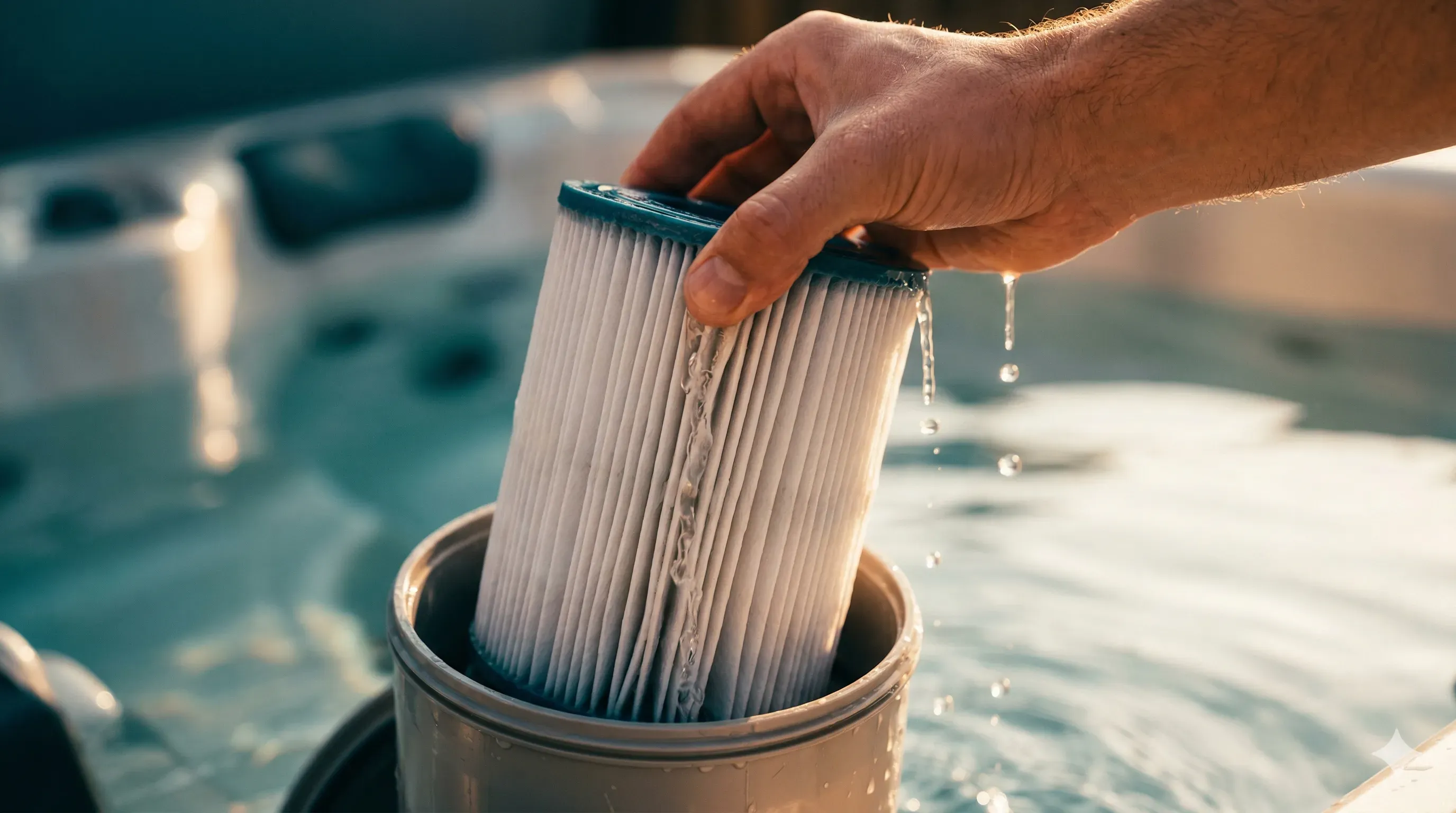
- Rinse the filter with a garden hose
- Wipe the waterline to prevent scum buildup
That’s roughly 15 to 20 minutes per week total. Most of it becomes automatic within a few weeks.
Full schedule including monthly and quarterly tasks: Hot Tub Maintenance Schedule
Step 5: Know your water chemistry basics
You don’t need a chemistry degree to maintain a hot tub, but understanding a few fundamentals saves you a lot of frustration.
pH drifts upward naturally in hot tubs because hot water releases CO2. You’ll be lowering pH more often than raising it. Small adjustments every few days are easier than big corrections once a week.
Sanitizer is the one number you can’t let slip. Bacteria double every 20 to 30 minutes at spa temperatures. A few days without adequate chlorine or bromine is enough for biofilm to establish in your plumbing and create recurring problems.
Hard water is the hidden variable. If your tap water is high in calcium (common in the Southwest and Midwest), you’ll deal with scale buildup unless you manage it from the start.
Step 6: Learn to spot problems early
Your senses catch problems before test strips do. Five signs your water needs attention:
- Cloudy water — usually low sanitizer. Full diagnosis guide.
- Chemical smell — chloramines, not too much chlorine. Why it happens and how to fix it.
- Skin feels off — pH is out of range.
- Persistent foam — body products, low calcium, or old water.
- Green or brown tint — metals or algae.
Catching these early means a quick fix. Ignoring them means a drain and refill.
All water problems and fixes: Hot Tub Troubleshooting Guide
Step 7: Drain and refill on schedule
Every 3 to 4 months, drain the tub completely, flush the plumbing, clean the shell, and start fresh. No chemical can compensate for water that’s been accumulating dissolved solids for six months. Fresh water resets everything and makes the next few months of maintenance much easier.
The short version
- Track four numbers (sanitizer, pH, alkalinity, calcium)
- Test two to three times per week
- Shock once a week
- Rinse the filter weekly, deep clean monthly
- Drain every 3 to 4 months
- Don’t ignore symptoms
That’s all there is to it. The rest is refinement you pick up over time.
Frequently asked questions
How hard is it to maintain a hot tub? Less than most people expect. Once you have a routine, it’s about 15 to 20 minutes per week. The first month involves more learning and testing as you figure out your water’s patterns. After that, it becomes second nature.
What chemicals do I need for a hot tub? Five or six: test strips, sanitizer (dichlor or bromine), pH decreaser, alkalinity increaser, shock oxidizer, and calcium hardness increaser if your water is soft. Everything else is optional. Here’s the full breakdown.
How often do I need to test hot tub water? Two to three times per week at minimum. Test before adding chemicals and 20 minutes after to confirm. During heavy use weeks, daily testing is worth the extra 30 seconds.
What’s the first thing to do with a new hot tub? Flush the plumbing. Factory residue and biofilm from the wet-test sit inside the pipes and will contaminate your first fill. Run a plumbing flush product through the jets for 20 minutes, drain, clean the shell, then refill and balance chemistry. Full startup guide.
Do I need to drain my hot tub regularly? Every three to four months. Dissolved solids build up from chemicals, bather waste, and evaporation. At some point the water is just too saturated for chemicals to work well. A fresh fill resets the slate.