Hot Tub Rash: What Causes It and How to Prevent It
Hot tub rash is a bacterial infection that starts with bad water chemistry. Learn how to identify it, treat it at home, and stop it from coming back.
Hot tub rash doesn’t start on your skin. It starts in the water. Specifically, it starts when sanitizer levels drop below the threshold that keeps a particular bacterium in check. The bacterium is always around. It lives in soil, tap water, and on surfaces. What matters is whether your water chemistry gives it room to multiply.
We’re a water care site, not doctors. If your rash is severe, spreading, or accompanied by fever, see a dermatologist. What we can tell you is exactly why your water allowed this to happen and how to make sure it doesn’t happen again.
What hot tub rash actually is
Hot tub rash is an infection of hair follicles caused by Pseudomonas aeruginosa, a bacterium that thrives in warm, moist environments. The medical name is Pseudomonas folliculitis. It’s not an allergic reaction. It’s not chemical irritation. It’s a genuine bacterial infection.
Here’s the number that should get your attention: an estimated 67% of hot tubs are contaminated with Pseudomonas aeruginosa at any given point in time, according to a study published in the National Institutes of Health database. The bacterium isn’t rare or exotic. It’s everywhere. The only thing standing between it and your skin is your sanitizer.
Symptoms typically appear 12 to 48 hours after soaking, sometimes up to 72 hours. That delay is why many people don’t connect the rash to the hot tub. By the time bumps show up, you’ve moved on from the soak and might blame laundry detergent, an allergic reaction, or even bed bugs.
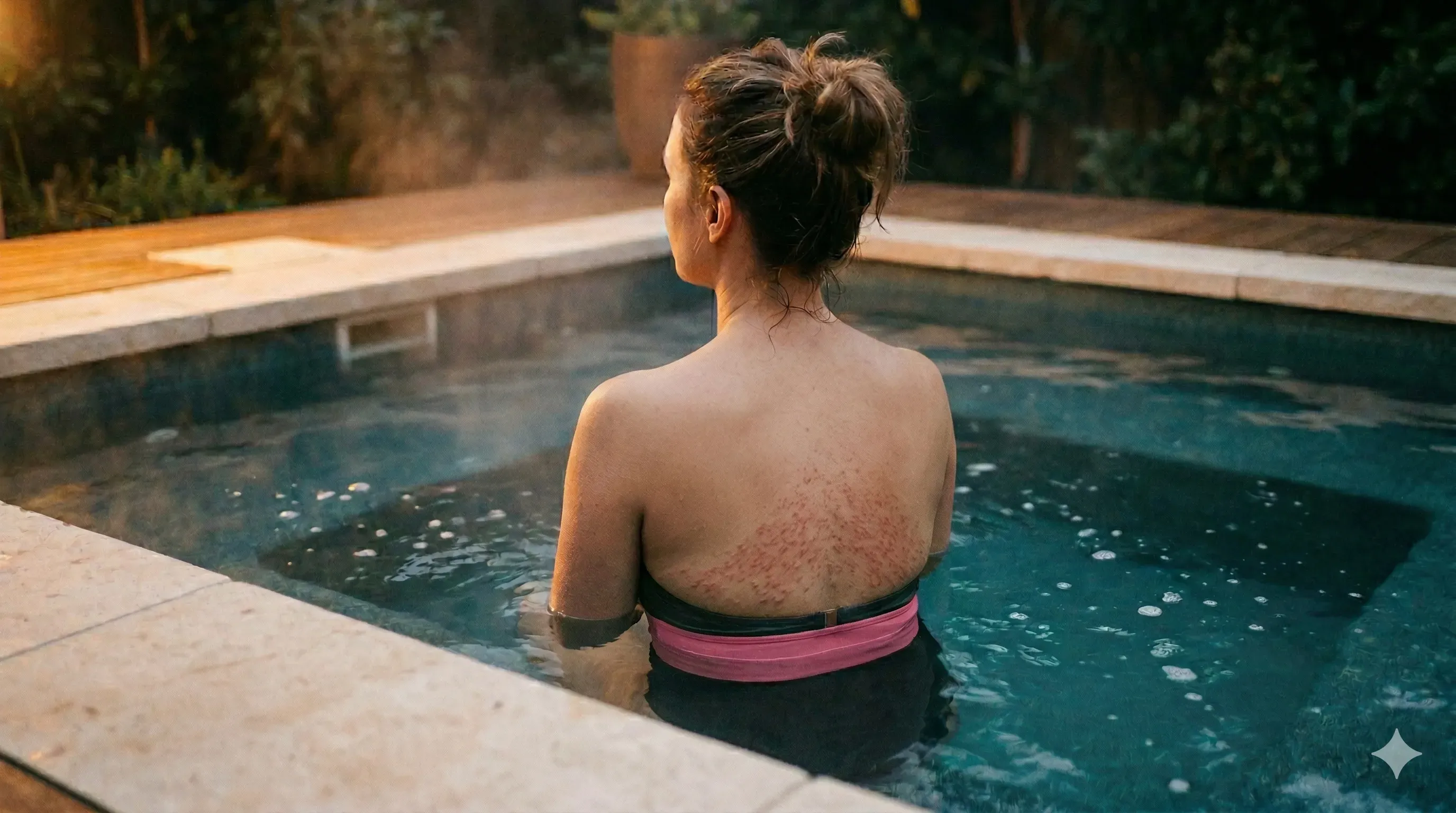
What it looks like: Red, round, itchy bumps (papules) that often develop into small pus-filled blisters. They range from 2 to 10 mm across and cluster in groups of several dozen.
Where it shows up: Worst in areas where your swimsuit held contaminated water against the skin. Buttocks, trunk, chest, and areas under straps are the most common locations. Honestly, this swimsuit-line pattern is the single most reliable way to identify it. If bumps are concentrated where fabric trapped water against your body, it’s almost certainly folliculitis.
Some people also develop mild fever, fatigue, or general achiness alongside the rash.
How to tell it apart from other rashes
Not every rash after a hot tub soak is folliculitis. Here’s how to distinguish the common types.
Hot tub folliculitis (bacterial): Distinct pus-filled bumps centered on hair follicles. Appears 12 to 48 hours after exposure. Worst under swimsuit. May include mild fever. Self-resolves in 7 to 14 days.
Chlorine rash (chemical irritation): General redness, dryness, flaking, and itching across all exposed skin. Starts during or immediately after soaking. No pustules, no pus. Clears when chlorine contact stops. Moisturizer helps. This happens from too much sanitizer or sensitive skin, not too little.
Heat rash (blocked sweat glands): Tiny bumps with a prickling or stinging sensation, concentrated in skin folds where sweat accumulates (chest, back, armpits). Happens during or right after heat exposure. Not related to water chemistry at all.
Chemical sensitivity or allergy: Raised welts (hives), swelling, and general redness. Appears during or soon after exposure to a specific chemical. Antihistamines help. This is an immune reaction to a product, not an infection.
The timing and pattern are your best diagnostic tools. Bacterial folliculitis has a delayed onset (12+ hours) and a swimsuit-line distribution. Everything else shows up during or immediately after the soak.
What causes hot tub rash: the water chemistry breakdown
Every case of hot tub folliculitis traces back to the same root cause: Pseudomonas aeruginosa was able to survive and multiply because sanitizer levels weren’t high enough to kill it. Here’s how that happens.
Low sanitizer is the number one cause
The CDC sets the minimum free chlorine level for hot tubs at 3 ppm, three times the 1 ppm minimum for swimming pools. Bromine minimum is 4 ppm. These numbers are higher than pool requirements because hot tub conditions are harder on sanitizer: temperatures of 100 to 104F accelerate chlorine decay, jets aerosolize water and drive off chlorine gas, and the water volume per bather is roughly nine times less than a pool. Everything concentrates faster and depletes faster.
Pseudomonas is readily killed by chlorine and bromine at adequate levels. Within seconds at 3 ppm free chlorine. The bacterium isn’t resistant to sanitizer. The problem is that hot tub conditions eat through sanitizer between tests, and levels can drop from 5 ppm to below 1 ppm in a single day of heavy use.
If you’re relying on test strips to catch that drop, you might miss it. A strip that reads “somewhere between 1 and 3” could mean 1.2 ppm, which is below the hot tub minimum. This is why accurate testing and consistent dosing matter more in a hot tub than a pool.
Biofilm shelters bacteria from sanitizer
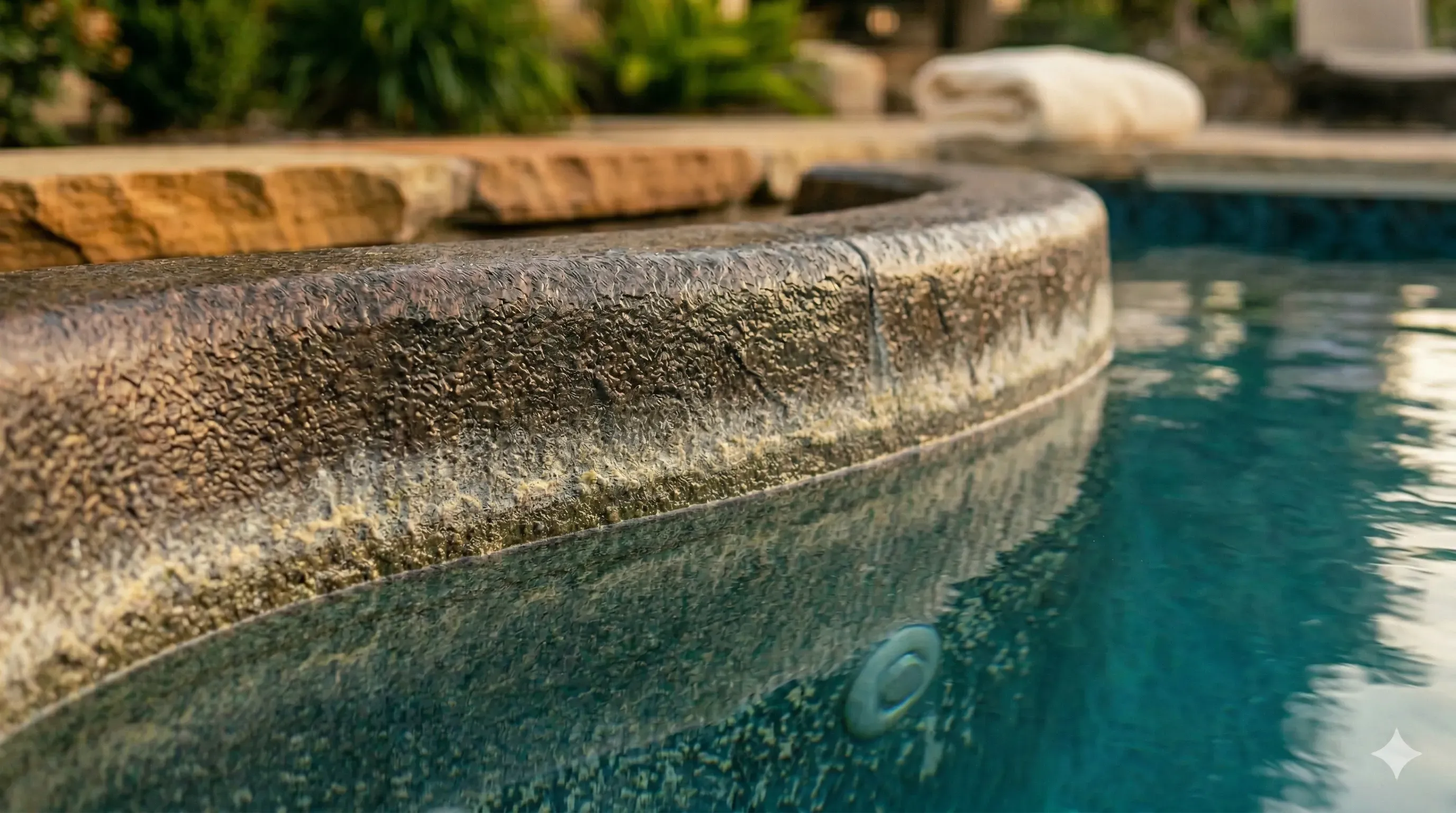
Here’s the part medical websites miss entirely. Biofilm is a slimy matrix of bacteria and organic material that forms inside your plumbing, on jet surfaces, in strainer baskets, and on pipe walls. The bacteria embed themselves in a protective layer that free chlorine can’t penetrate.
When you run the jets, pieces of biofilm break loose and enter the water. You can have 5 ppm free chlorine in the tub and still introduce Pseudomonas from biofilm deep in the plumbing where chlorine never reaches. The bacteria survive in the biofilm, get flushed into the bulk water, and deplete the free chlorine locally before it can kill them all.
And that’s why people get recurring rashes from their own tub even after “cleaning” it. Draining the tub and wiping down the shell doesn’t touch the biofilm inside the plumbing. The bacteria come right back with the first jet cycle. Fixing this requires a line flush with a product like Ahh-Some or Natural Chemistry Spa Purge before draining.
After a documented case where a father got folliculitis, treated it with antibiotics, cleaned the tub with bleach but didn’t flush the lines, and got reinfected two weeks later, researchers noted that the pump wasn’t cleaned and water remained in the internal mechanism. Surface cleaning isn’t enough.
pH amplifies the problem
Even when free chlorine reads adequate, high pH quietly undermines it. At pH 7.4, about 53% of your chlorine is in the active form (hypochlorous acid) that kills bacteria. At pH 8.0, only about 22% is active. You could have 3 ppm free chlorine on your test strip and still have weak sanitation because three quarters of that chlorine is sitting idle in the wrong chemical form.
That’s why the CDC recommends pH between 7.0 and 7.8 for hot tubs. Above 7.8 and your sanitizer is working at a fraction of its capacity, which is exactly the gap Pseudomonas exploits.
How to treat hot tub rash at home
Most cases resolve on their own in 7 to 14 days without medical intervention. The CDC describes the condition as self-limited.
At home:
- Apply over-the-counter hydrocortisone cream to reduce itching
- Use warm compresses for 15 to 20 minutes, a few times a day
- Wash affected areas gently with antibacterial soap
- Don’t scratch or pick at the bumps (risk of secondary infection)
- Remove your swimsuit and shower with soap as soon as possible after soaking
See a doctor if:
- The rash hasn’t improved after two weeks
- Symptoms are getting worse or spreading
- You develop fever, chills, or increasing pain
- You notice breast or chest tenderness with swollen lymph nodes (a documented pattern with severe Pseudomonas infection)
- You’re immunocompromised (diabetes, HIV, undergoing chemotherapy)
- The rash keeps coming back
The standard prescription when antibiotics are needed is ciprofloxacin 500 mg twice daily for seven days, which targets Pseudomonas specifically.
Before you get back in the tub: Fix the water first. Getting back in with the same chemistry that caused the rash will cause it again. Shock the tub, verify sanitizer and pH levels, and if you suspect biofilm, flush the lines and drain before using it again.
How to prevent hot tub rash
Prevention is straightforward water chemistry. Every item on this list is something you’re already supposed to be doing for basic hot tub maintenance. If you’re doing all of them consistently, folliculitis is extremely unlikely.
Maintain sanitizer levels. Free chlorine at 3 to 5 ppm, or bromine at 4 to 6 ppm. Test two to three times per week minimum. Test before every soak if you can. The CDC hot tub minimum of 3 ppm chlorine exists specifically because hot tub conditions deplete sanitizer faster than pools.
Keep pH between 7.2 and 7.6. Not just “below 7.8.” At 7.4, your chlorine is about 53% active. At 7.8, it’s dropped to about 30%. That difference matters when you’re relying on chlorine to kill a bacterium that’s present in two thirds of hot tubs.
Shock weekly. An oxidizing shock treatment breaks down organic waste that accumulates between regular sanitizer doses. It also helps control biofilm growth.
Flush lines before every drain. Use Ahh-Some or Spa Purge to circulate through the plumbing and break up biofilm before you drain the water. A simple drain leaves the biofilm intact inside the pipes.
Drain every 3 to 4 months. Fresh water resets your TDS, dilutes any accumulated contaminants, and gives you a clean starting point. Don’t stretch intervals just because the water looks clear.
Clean or replace filters on schedule. Dirty filters can harbor bacteria and reduce water flow, creating stagnant zones where Pseudomonas thrives.
Shower before and after soaking. The CDC estimates that a pre-soak shower removes about 70% of the contaminants on your skin (lotions, oils, cosmetics) that would otherwise enter the water and consume sanitizer. Showering after and removing your swimsuit promptly reduces prolonged contact with any bacteria you picked up.
Hotels, Airbnbs, and public hot tubs
You can’t control the maintenance on a tub you don’t own. But you can check a few things before getting in.
Look at the water. It should be clear, not cloudy or greenish. You should be able to see the bottom clearly.
Feel the walls below the waterline. If they feel slimy, biofilm is present and the tub hasn’t been maintained. Don’t get in. Seriously.
Smell the air above the water. A strong chemical smell means chloramines (combined chlorine), which means the free chlorine has been used up reacting with contaminants. That’s the opposite of well-maintained water. A slight, clean chlorine scent is fine. No smell at all might mean no sanitizer.
Bring a test strip. Toss one in the water before you soak. It takes 15 seconds. If free chlorine is below 3 ppm or pH is above 7.8, the water isn’t safe.
Shower immediately after. Even if the water tested fine. You don’t know the full history of the tub, who was in it before you, or when chemicals were last added.
Hotel hot tubs and vacation rentals account for a disproportionate share of hot tub rash cases. CDC data shows that 70% of hotel and resort outbreaks with confirmed etiology were associated with hot tubs specifically. Almost 80% of routine inspections of public aquatic venues found at least one violation. You’re not being paranoid by checking first.
A note on Legionnaires’ disease and hot tub lung
These are different conditions from folliculitis but worth knowing about because they share the same root cause: poorly maintained hot tub water.
Legionnaires’ disease is a serious pneumonia caused by Legionella bacteria. It spreads through breathing in aerosolized water droplets, not through skin contact. Hot tub jets create exactly those aerosols. Between 2015 and 2019, Legionella caused 65 outbreaks associated with treated recreational water, and all 13 deaths in that period were from Legionnaires’ disease.
Hot tub lung is a granulomatous lung disease caused by Mycobacterium avium complex. It affects mostly indoor hot tubs with poor ventilation, where aerosolized bacteria accumulate in enclosed air.
Both are prevented by the same measures that prevent folliculitis: adequate sanitizer levels, proper pH, regular shocking, biofilm management, and good ventilation for indoor installations.
Frequently asked questions
What does hot tub rash look like? Red, round, itchy bumps that often contain pus. They look like acne but appear in clusters, worst in areas where your swimsuit held contaminated water against skin, like the buttocks, chest, and trunk. They show up 12 to 48 hours after soaking.
How long does hot tub rash last? Most cases resolve on their own in 7 to 14 days without treatment. The itching is usually worst in the first few days. If the rash hasn’t improved after two weeks or is getting worse, see a doctor. Ciprofloxacin is the standard prescription if antibiotics are needed.
Is hot tub rash contagious? Not person to person. You can’t catch it from someone who has it. But you can both get it from the same contaminated water. If multiple people who shared a hot tub develop the rash within a few days, the water is the source, not each other.
Can you get hot tub rash from a well maintained hot tub? It’s unlikely if sanitizer levels are consistently at 3 ppm free chlorine or above and pH stays between 7.2 and 7.8. The bacteria that causes it, Pseudomonas aeruginosa, is killed within seconds at those levels. Most cases trace back to a moment when chemistry slipped.
What is the difference between hot tub rash and chlorine rash? Hot tub rash is a bacterial infection with distinct pus filled bumps centered on hair follicles, appearing 12 to 48 hours after exposure. Chlorine rash is chemical irritation with general redness, dryness, and flaking that starts during or immediately after soaking. No pustules with chlorine rash.
What kills Pseudomonas in a hot tub? Free chlorine at 3 ppm or above, or bromine at 4 ppm or above, kills Pseudomonas aeruginosa within seconds in properly balanced water. The bacterium isn’t resistant to sanitizer. The problem is that hot tub conditions deplete sanitizer fast, and biofilm in plumbing shelters bacteria from chlorine.