Salt Water Hot Tubs: How They Work and What to Know
Salt water hot tubs still use chlorine. The system just makes it for you. This is the honest breakdown of how they actually work and who they make sense for.
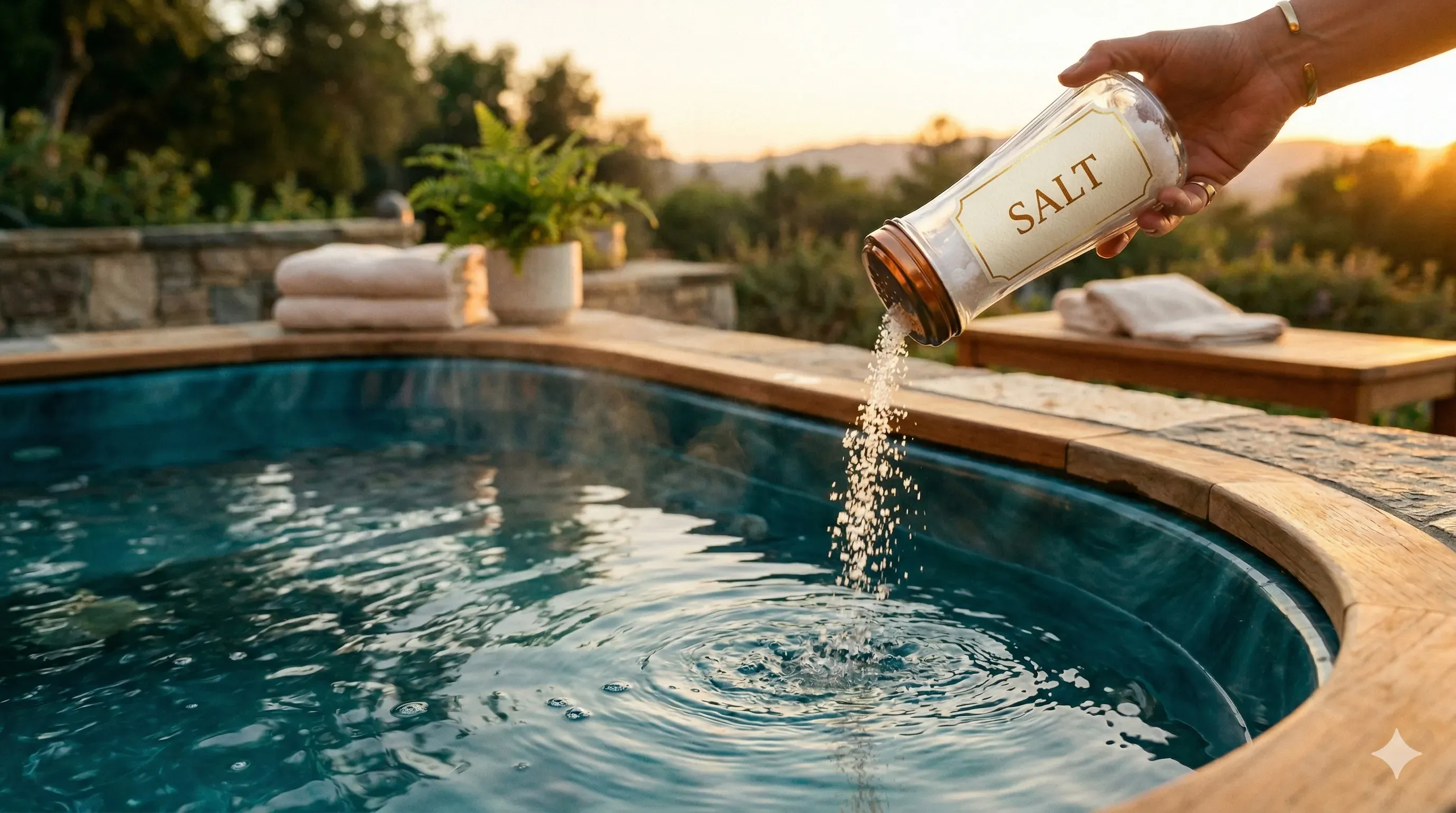
Salt water hot tubs still use chlorine. That’s the single most important fact about them, and it’s the one that most marketing material buries or skips entirely. The system doesn’t eliminate chlorine. It generates chlorine from salt through electrolysis. The water in a salt hot tub is chlorinated water. The difference is how the chlorine gets there, not what it is.
That said, salt systems are different to own in ways that matter. The water feels softer. There’s less chemical smell. You handle fewer containers and do less manual dosing. Whether those benefits are worth the tradeoffs depends on your situation, and those tradeoffs are real.
How salt water systems actually work
A salt chlorine generator passes water through a cell containing titanium plates. You dissolve pool-grade sodium chloride (salt) into the water to reach a target concentration, typically 1,500 to 3,000 ppm depending on the system. A low-voltage electrical current runs through the cell and splits the salt molecules apart.
The chlorine side of the molecule reacts with water to form hypochlorous acid, the exact same active sanitizer produced by granular chlorine, liquid bleach, and chlorine tablets. It kills bacteria, oxidizes organic contaminants, and keeps the water safe. After it does its work, the hypochlorous acid breaks back down into sodium and chloride ions. The salt is available to be converted again. It recycles.
Here’s the part that actually affects your daily routine: the electrolysis also produces sodium hydroxide (NaOH) at the other electrode. Sodium hydroxide is a strong base. It pushes pH upward every hour the cell runs. This is the root cause of the pH management that salt system owners deal with constantly. It’s not a flaw or a malfunction. It’s basic chemistry built into the process.
At 1,750 ppm, salt water in a hot tub is about one twentieth the salinity of ocean water. You won’t taste it. It’s closer to the salt content of a teardrop than the ocean. Don’t use table salt, which contains iodine and anticaking agents that interfere with the cell. Pool-grade sodium chloride or the manufacturer’s recommended product only.
Salt water vs chlorine vs bromine
You already have three sanitizer options for a hot tub. Salt is a third delivery method, not a third chemical. Here’s how they compare honestly.
| Salt System | Manual Chlorine | Bromine | |
|---|---|---|---|
| Active sanitizer | Hypochlorous acid (HOCl) | Hypochlorous acid (HOCl) | Hypobromous acid (HOBr) |
| How it gets there | Auto-generated by electrolysis | You add granules or bleach | Tablets dissolve in a floater or feeder |
| Water feel | Softer, silkier, less smell | Can feel harsher after fresh doses | Milder smell than chlorine, slightly softer |
| pH behavior | Constantly drifts upward | Stable or slight drift depending on product | Stable |
| Heat stability | Same as chlorine (degrades in hot water) | Degrades faster in hot water | Holds up better at hot tub temps |
| Effective at high pH? | Same as chlorine (less effective above 7.6) | Less effective above 7.6 | More effective across a wider pH range |
| Manual dosing frequency | Rarely for sanitizer, frequently for pH | 2 to 3 times per week for sanitizer | Less frequent than chlorine, more than salt |
| Equipment cost | High (system + cell replacements) | Low (no special equipment) | Low to moderate (floater or inline feeder) |
If you already use chlorine and want to compare bromine vs chlorine in more detail, that’s a separate conversation. The salt question is really about whether automating chlorine production is worth the equipment cost and the different maintenance profile.
The real advantages
The water feels different. Ask anyone who owns a salt system what they like most, and this is what they say first. And it’s legitimate. Continuous low-level chlorine generation means fewer chloramines (the irritating byproduct that causes “chlorine smell” and eye burning). Less chemical smell on your skin and hair after soaking. Less drying. Some owners with eczema or sensitive skin report genuine improvement.
Less manual chemical handling. You’re not measuring granules, you’re not opening chlorine containers two or three times a week, you’re not storing chemical bottles. The system handles sanitizer production. That convenience is real.
More consistent sanitizer levels. Manual dosing creates a saw-tooth pattern: dose, levels spike, levels decay, dose again. Salt systems generate chlorine continuously in small amounts. The result is steadier free chlorine with fewer peaks and valleys, which means fewer chloramine episodes.
Gentler on swimwear. The consistent low-level chlorine fades swimsuits less than periodic manual doses that spike to 5 ppm or above.
The real downsides
pH management becomes a constant task. Honestly, this is the number one complaint from real salt system owners. Electrolysis produces sodium hydroxide as a byproduct. pH drifts upward every day the cell runs. You’ll add pH decreaser (sodium bisulfate) weekly or more often. Some owners report spending more time managing pH with a salt system than they ever spent dosing chlorine manually. Arctic Spas specifically warns that pH must not exceed 7.6 with their Onzen system.
Cell replacement is a recurring cost. Salt cells don’t last forever. Hot Spring FreshWater cartridges are rated for about four months each, though real-world lifespan ranges from six weeks to nine months depending on usage, calcium levels, and maintenance. ACE cells last two to three years but cost considerably more. Aftermarket cells like the ControlOMatic ChlorMaker last two to three years at a lower replacement cost. This is an ongoing expense that traditional chlorine doesn’t have.
Corrosion is real, not theoretical. Multiple documented cases on Trouble Free Pool forums show heater destruction within a year of adding an aftermarket salt system, even at proper salt levels. The electrolysis process combined with elevated pH stresses heater elements, pump seals (especially Buna rubber), and metal fittings. Tubs designed for salt from the factory use titanium or marine-grade stainless steel components. Aftermarket conversions on tubs built with standard stainless steel are the highest risk.
Calcium management changes completely. Salt electrolysis creates a localized high-pH zone near the cell plates, which accelerates calcium precipitation. Scale builds on the cell, reduces chlorine output, and shortens cell life. Factory salt systems like the Hot Spring FreshWater target calcium hardness of just 25 to 75 ppm, way lower than the 150 to 250 ppm range for traditional hot tubs. The FreshWater system even includes a “Vanishing Act” calcium removal tool for this reason.
Warranty voiding is a serious concern. Jacuzzi explicitly does not recommend salt water systems and will void your warranty if one is installed. Many other manufacturers have similar policies for aftermarket systems. Even with factory-installed systems, corrosion damage may not be covered if attributed to chemical abuse. Always check with your manufacturer before converting.
You still need to shock. Non-chlorine shock (potassium monopersulfate) is still needed weekly to oxidize organic waste like body oils, lotions, and sweat that the continuous chlorine generation doesn’t fully handle.
Water chemistry targets for salt systems
Salt systems run different chemistry targets than traditional hot tubs. This catches new salt owners off guard.
| Parameter | Salt System Target | Traditional Target |
|---|---|---|
| pH | 7.2 to 7.6 (lower ideal to offset constant upward drift) | 7.2 to 7.8 |
| Total alkalinity | Under 100 ppm (lower TA means less resistance when correcting pH drift) | 80 to 120 ppm |
| Calcium hardness | 25 to 75 ppm (FreshWater system) | 150 to 250 ppm |
| Free chlorine | 1 to 5 ppm | 1 to 3 ppm (chlorine) or 3 to 5 ppm (bromine) |
The lower alkalinity target is counterintuitive but makes sense once you understand the pH drift problem. Lower TA means less buffering, which means pH rises more slowly, and when you do add acid it actually works instead of fighting against a high buffer.
The calcium hardness difference is the biggest shift. If you’re coming from traditional chlorine or bromine and your tub has been running at 200 ppm calcium, you need to drain and refill with a plan to keep calcium low from the start.
Can you convert your existing hot tub?
Technically, most tubs can accept an aftermarket drop-in salt system like the ControlOMatic ChlorMaker or Saltron Mini. Drop-in units sit in the water or drape over the shell and operate independently from your spa’s control system. No plumbing modifications needed. Installation takes under an hour.
Before you do it, check three things:
Your warranty. If your tub is under warranty, an aftermarket salt system will likely void it. The risk is yours.
Your heater. Standard stainless steel heaters can corrode in salt water. Tubs designed for salt use titanium-coated or marine-grade heaters. If you’re converting, confirm what material your heater element is. Upgrading to a titanium heater before converting is the safe approach.
Your fill water. Hard water areas make salt systems harder to maintain because calcium scaling on the cell is a constant battle. If your tap water is above 200 ppm calcium hardness, you’ll need a pre-filter or plan for very frequent cell cleaning.
Factory-integrated systems (Hot Spring FreshWater, Arctic Spas Onzen) are designed with all components tested for salt compatibility. They run at lower salt concentrations (1,500 to 1,800 ppm versus 3,000+ ppm for aftermarket), which is gentler on everything.
Salt water vs ozone and UV
These get lumped together as “alternative sanitizers” but they work completely differently.
Ozone generators produce O3, a powerful oxidizer that destroys bacteria and organics on contact. But ozone has a half-life of only 15 to 30 seconds. It provides no lasting residual in the water. You still need chlorine or bromine for protection between pump cycles.
UV-C systems (like Jacuzzi’s CLEARRAY) pass water under ultraviolet light that disrupts bacterial DNA. It’s effective at the point of contact but leaves zero residual. You still need a halogen sanitizer.
Salt is the only system of the three that produces its own residual sanitizer. The chlorine it generates stays in the water and keeps working when the pump cycles off.
Many premium spas combine systems. Salt plus ozone, or UV plus minerals, or all three. No combination eliminates the need for a halogen residual entirely.
Who should get a salt system
Salt makes the most sense if you value the water feel and reduced chemical handling enough to accept the different maintenance profile. Owners who love their salt systems consistently say the water feels better than anything they’ve experienced with manual chlorine or bromine.
Salt makes less sense if you’re looking for truly low-maintenance water care. The tasks change, but they don’t disappear. You trade chlorine dosing for pH management and cell maintenance. If pH management sounds tedious to you, traditional chlorine with a good maintenance schedule might actually be less work overall.
Salt is a poor fit if your fill water is very hard, if your tub has cheap metal components, if you’re buying a budget tub and adding an aftermarket system to save on chemicals (the math rarely works out), or if keeping the manufacturer warranty is important to you.
The honest take: salt water hot tubs are a premium experience with premium maintenance requirements. The water does feel better. The marketing around “chemical free” and “maintenance free” is flat out wrong.
Frequently asked questions
Do salt water hot tubs still use chlorine? Yes. A salt water system is a chlorine generator. It splits dissolved salt (sodium chloride) into sodium and chlorine through electrolysis. The chlorine sanitizes the water, then reverts back to salt and cycles again. The active sanitizer is identical to what you’d get from granular chlorine.
Are salt water hot tubs chemical free? No. You still need pH decreaser (more often than traditional tubs because electrolysis pushes pH up), non chlorine shock weekly, and alkalinity and calcium management products. The system automates chlorine production but doesn’t eliminate other chemical needs.
Can you convert any hot tub to salt water? Most tubs can accept an aftermarket salt system, but check your warranty first. Many manufacturers void coverage if an aftermarket salt generator is installed. Tubs with non titanium heaters and lower grade stainless steel fittings are at higher risk of corrosion from salt.
How long does a salt cell last? It depends on the system. Hot Spring FreshWater cartridges are rated for about four months each. Aftermarket cells like the ControlOMatic ChlorMaker last two to three years. The original Hot Spring ACE cell lasts two to three years but costs considerably more to replace.
Is a salt water hot tub worth it? If you value softer water, less chlorine smell, and less manual chemical handling, yes. If you expect zero maintenance or think it eliminates chemicals, you’ll be disappointed. Salt systems trade one set of tasks (dosing chlorine) for another (managing pH drift and cleaning cells).
Do salt water hot tubs cause corrosion? They can. Electrolysis produces sodium hydroxide as a byproduct, which raises pH. High pH accelerates calcium scaling and can corrode heater elements, pump seals, and metal fittings. Tubs designed for salt use titanium or marine grade components. Aftermarket conversions on standard tubs carry more risk.