What Chemicals Does a Saltwater Hot Tub Still Need?
Salt systems generate chlorine, not magic. Every chemical you still need, why pH becomes your biggest chore, and what the brochure left out.
The pitch sounds great: add salt instead of chlorine. Fewer chemicals. Softer water. Every saltwater hot tub brochure reads like a vacation from water chemistry.
The reality is different. A salt system automates one part of your routine (adding chlorine) and introduces a new set of challenges you didn’t have before (pH drift, cell scaling, corrosion risk). You still need chemicals. You still need to test. And the one chore you thought you were eliminating, pH adjustment, actually gets worse.
Below: what the salt cell actually does, every chemical you still need, and what the brochure left out.
How a salt system actually works
A salt chlorine generator dissolves sodium chloride (NaCl) in your hot tub water at a low concentration, usually 1,750 to 3,000 ppm depending on your system. For reference, ocean water runs about 35,000 ppm. At hot tub levels, most people can’t taste the salt.
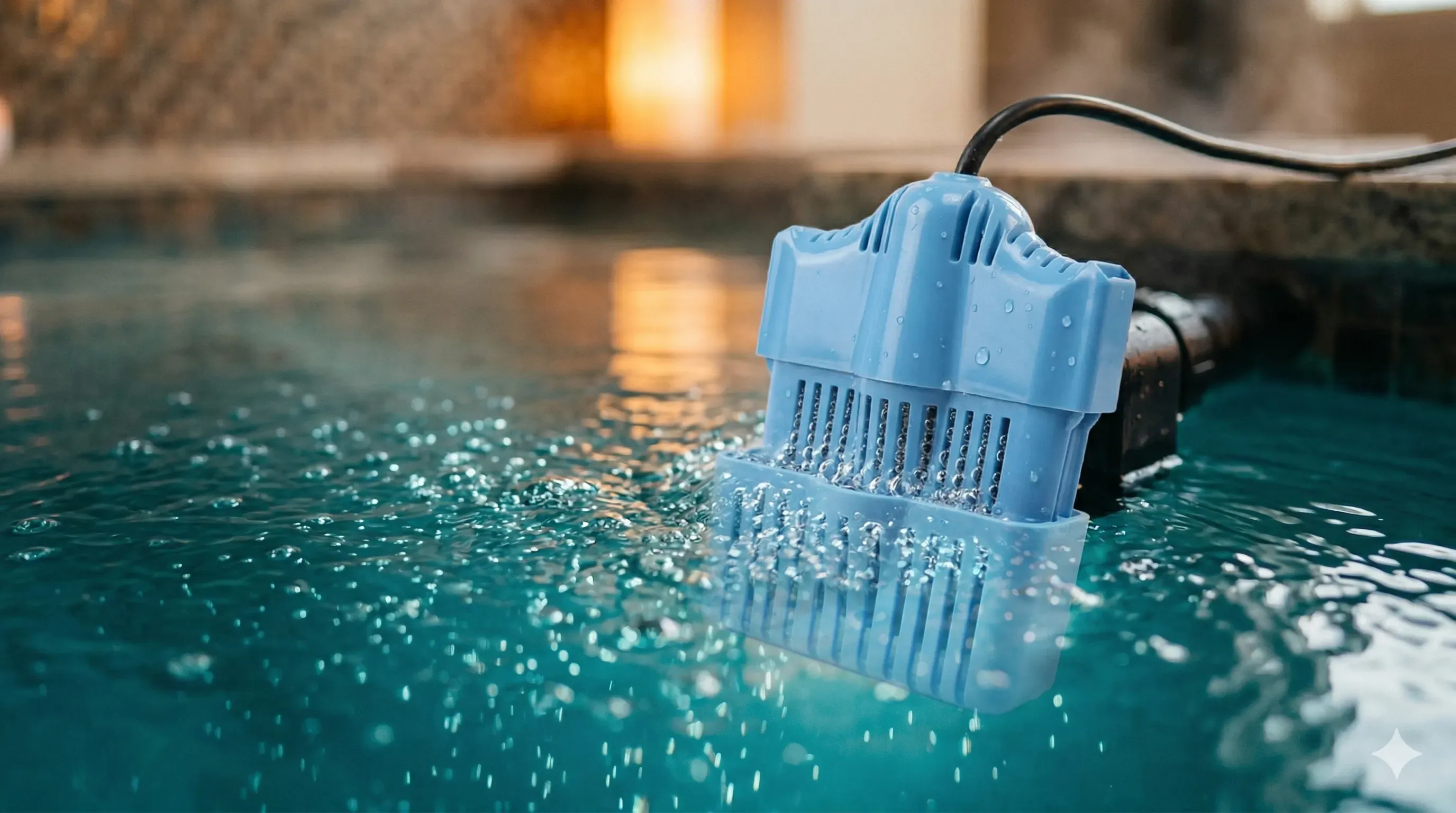
Water flows through a salt cell, which is a set of titanium plates coated with precious metals. A low-voltage current splits the salt and water molecules (electrolysis), producing hypochlorous acid (HOCl). That’s the exact same sanitizer you’d get from dichlor granules or liquid bleach. Once HOCl does its job and breaks down, it recombines back into salt and the cycle starts over. Pretty elegant, honestly.
A saltwater hot tub isn’t chlorine free. It generates chlorine automatically from salt instead of you adding it by hand. The water contains real chlorine at 1 to 3 ppm, the same concentration as a traditionally sanitized tub.
Every chemical you still need
The salt cell handles sanitizer production. Everything else is still on you.
pH decreaser (your new best friend)
Plan to buy pH decreaser in bulk. Electrolysis produces sodium hydroxide (NaOH) as a direct byproduct at the cathode. Sodium hydroxide has a pH above 13. It keeps pushing your water’s pH upward, every hour of every day.
Hydrogen gas produced during electrolysis doesn’t dissolve in water and off-gasses at the surface. This drives dissolved CO2 out of the water, and less CO2 means less carbonic acid, which means pH rises further.
Salt systems naturally drive pH toward the 7.6 to 8.0 range. You’ll add pH decreaser (sodium bisulfate) every few days, sometimes more often during heavy use. At pH 8.0, only about 22% of your chlorine is in the active form. The salt cell can generate chlorine all day, but if pH is too high, most of it sits idle in the wrong chemical form.
Nobody warns you about this part. You trade daily chlorine dosing for frequent pH correction. Most owners find the trade worthwhile because pH decreaser is simpler than measuring sanitizer, but it’s not the hands-off experience the marketing suggests.
Total alkalinity adjusters
Alkalinity buffers pH. If it’s too high, pH locks above 7.8 and resists correction. If it’s too low, pH bounces around unpredictably. Target 80 to 120 ppm, same as any hot tub. Adjust alkalinity before pH, always.
Salt systems don’t affect alkalinity directly, but the constant pH correction with sodium bisulfate can gradually pull alkalinity down as a side effect. Test weekly and top up with baking soda if it drops below 80 ppm.
Calcium hardness management
Calcium management is where most salt system owners run into trouble. The salt cell creates a localized high-pH zone on the titanium plates during electrolysis. High pH plus dissolved calcium equals calcium carbonate precipitation, directly on the cell plates. Scale on the cell reduces chlorine output and shortens cell lifespan.
Some manufacturers recommend lower calcium hardness than traditional tubs to protect the salt cell. Targets as low as 50 ppm are common for certain systems, while others stay in the standard 150 to 250 ppm range. Check your system’s manual for the specific recommendation.
If you have hard fill water, a hose pre-filter at fill time strips out a good chunk of calcium before it enters the tub. This protects both the cell and the heater.
Non-chlorine shock (MPS)
The salt cell produces a steady low level of chlorine. It’s enough for routine sanitation but not enough to handle the burst of organic contamination from a heavy soak. Body oils, sweat, lotions, and cosmetics need an oxidizer to break them down.
Add MPS (potassium monopersulfate) weekly, or after heavy use. About 2 ounces per 250 gallons. Some owners also keep dichlor granules on hand for situations where the cell can’t keep up, like after a party or when the cell is nearing end of life.
Metal sequestrant
Add at every drain and refill. Fill water contains dissolved iron, copper, and manganese that are invisible until chlorine oxidizes them into visible stains. A sequestrant binds these metals and lets the filter remove them. This protects your shell from staining and your salt cell from mineral deposits.
Salt (obviously)
Pool-grade or spa-grade sodium chloride, at least 99.8% pure, non-iodized, no anti-caking agents. Do not use table salt, rock salt, Epsom salt, or Himalayan pink salt. Impurities stain your shell and gum up the salt cell.
Target salt level depends on your system:
| System | Target Salt Level |
|---|---|
| Factory integrated systems | 1,500 to 2,000 ppm (varies by brand) |
| Standard aftermarket systems | 2,000 to 3,000 ppm |
Add salt slowly, testing between additions. About 2.3 cups per 100 gallons reaches roughly 1,750 ppm in fresh water. Salt doesn’t evaporate, so you only need to add more after water changes, heavy splash-out, or dilution from rain.
What you don’t need with a salt system
A few things come off the list:
- Dichlor granules or bromine tablets for routine dosing (the cell handles this)
- Floating dispensers (no tablets to dissolve)
- Liquid bleach for daily sanitizing (though keeping some on hand for emergencies is smart)
You may still want dichlor granules for a one-time boost when the cell can’t keep up, but it’s a backup, not a daily routine.
The salt system vs traditional: what actually changes
| Task | Traditional Chlorine | Saltwater |
|---|---|---|
| Add sanitizer | Every soak or every other day | Automatic (cell generates it) |
| Adjust pH | A few times per week | More often (electrolysis pushes pH up constantly) |
| Adjust alkalinity | Weekly check | Weekly check |
| Manage calcium | Monthly check | More important (protects the cell) |
| Shock | Weekly | Weekly |
| Test water | 2 to 3 times per week | 2 to 3 times per week |
| Add metal sequestrant | At each refill | At each refill |
| Clean salt cell | N/A | Every 60 to 90 days |
| Replace salt cell | N/A | Every 2 to 5 years (or 4 months for cartridge systems) |
| Drain and refill | Every 3 to 4 months | Every 4 to 12 months (varies by system) |
Not measuring chlorine before every soak is genuinely easier. But the total work doesn’t shrink. It shifts from “add sanitizer often” to “manage pH often and maintain the cell.”
Salt cell maintenance
Cleaning (permanent cells)
Inspect the cell every 30 days for white, flaky calcium deposits on the plates. Clean every 60 to 90 days or when you see buildup.
Vinegar method (gentler): Soak the cell in undiluted white vinegar for several hours, up to 24 hours for heavy buildup. Rinse thoroughly.
Muriatic acid method (stronger): Mix 4 parts water to 1 part muriatic acid (always add acid to water, never the reverse). Soak the cell for 10 to 15 minutes until fizzing stops. Rinse thoroughly. Wear gloves and eye protection.
Don’t over-clean. Frequent acid washes strip the precious-metal coating from the titanium plates and shorten cell life. Clean only when you see scale, not on a rigid schedule.
Replacement
Permanent salt cells last 2 to 5 years depending on water balance, usage, and cleaning habits. Maintaining proper calcium hardness and pH extends cell life. Running the cell at maximum output constantly shortens it.
Some factory systems use disposable titanium cartridges that last about 4 months each. No cleaning required. Remove, discard, insert a new one. Aftermarket drop-in systems use replaceable cells that usually last 12 to 18 months.
Problems the brochure skips
Corrosion
Salt is corrosive to metals. In a hot tub, the combination of elevated salt concentration, 104°F water, and continuous circulation creates a corrosive environment for heater elements, pump seals, jet hardware, and electrical connections.
The nuance: at 1,750 to 3,000 ppm, salt alone isn’t the primary corrosion driver. pH imbalance is. Low pH (below 7.0) is especially corrosive, and owners who over-correct with acid to fight the constant pH rise can swing into corrosive territory. Keeping pH in the 7.2 to 7.6 range protects equipment regardless of salt concentration.
Hot tubs designed for salt from the factory use corrosion-resistant heaters and fittings rated for saltwater. Aftermarket salt systems installed on tubs not engineered for salt are where most damage reports come from.
Insufficient chlorine production
The salt cell generates chlorine at a steady rate. During heavy use (multiple bathers, long soaks, a hot day that accelerates chlorine degradation), the cell may not keep up. Free chlorine drops to zero, and bacteria multiply fast at 104°F.
Keep dichlor granules or liquid bleach on hand for manual supplementation. If you’re constantly supplementing, the cell may be undersized for your usage, scaled up, or nearing end of life.
Warranty concerns
Some major manufacturers explicitly warn that salt chlorine generators are not recommended for their hot tubs and that using one voids the warranty. Several brands have similar policies for tubs not sold with a factory salt option. Always check your warranty terms before converting.
Before adding an aftermarket salt system, check your warranty terms. The tub’s heater and metal components may not be rated for saltwater, and replacing a corroded heater assembly costs more than years of dichlor granules.
Environmental disposal
Salt water can damage lawns, plants, and soil when you drain. Some municipalities restrict saltwater discharge. Before your first drain, check your local regulations. Draining onto a gravel pad or storm drain (where permitted) avoids turf damage.
Who should (and shouldn’t) go salt
Salt makes sense if:
- Your tub was designed for it from the factory
- You value softer-feeling water and less chlorine odor on your skin
- You’re willing to trade daily sanitizer dosing for frequent pH management
- You accept the cell replacement cost as an ongoing expense
Skip salt if:
- Your tub wasn’t built for salt and the manufacturer warns against it
- You want genuinely lower maintenance (the total work is roughly equal, just different)
- You’re looking to save money (cell replacement offsets chemical savings for most owners)
- You’re on well water with very high calcium (accelerates cell scaling)
For most hot tub owners, the dichlor/bleach method provides effective sanitation without cell maintenance, corrosion risk, or replacement parts. Salt systems shine on convenience and water feel, not on overall simplicity.
The complete saltwater chemical checklist
Print this out and keep it with your test kit.
At every fill:
- Pool-grade salt to target ppm
- Metal sequestrant (circulate before other chemicals)
- Balance alkalinity (80 to 120 ppm)
- Balance pH (7.4 to 7.6)
- Check calcium hardness (per manufacturer specs)
- Activate salt cell after water is balanced
Weekly:
- Test pH and free chlorine (2 to 3 times)
- Add pH decreaser as needed
- MPS shock after heavy use or weekly
- Check salt level with salt-specific test strips
Monthly:
- Inspect salt cell for scale
- Test alkalinity and calcium hardness
- Clean the filter
Every 60 to 90 days:
- Clean salt cell if needed (vinegar or dilute acid)
Every 3 to 12 months (varies by system):
- Drain and refill
- Replace salt cell or cartridge per manufacturer schedule
Frequently asked questions
Do saltwater hot tubs still need chemicals? Yes. A salt system generates chlorine automatically, so you skip the daily chlorine dosing. But you still need pH decreaser (frequently), alkalinity increaser, calcium management, weekly shock, metal sequestrant at every fill, and test strips. The brochure says fewer chemicals. The reality is different chemicals, not none.
Are saltwater hot tubs actually chemical free? No. The salt cell converts sodium chloride into hypochlorous acid, the exact same chlorine produced by dichlor granules or liquid bleach. You are soaking in chlorinated water at 1 to 3 ppm. The system automates the delivery, but the chlorine is real.
Why does my saltwater hot tub pH keep rising? Electrolysis produces sodium hydroxide as a direct byproduct. Sodium hydroxide has a pH above 13 and keeps pushing your water upward. Hydrogen gas off-gassing also causes CO2 loss, which raises pH further. This is inherent to all salt chlorine generators, not a defect. Budget for frequent pH correction.
How often do you replace a salt cell? Permanent cells last 2 to 5 years with good maintenance. Disposable cartridge systems last about 4 months per cartridge. Cell lifespan depends on water balance. High calcium and high pH cause scaling that cuts cell life short.
Can any hot tub be converted to saltwater? Technically yes, with an aftermarket salt chlorine generator. But many manufacturers void the warranty if you add salt to a tub not designed for it. Salt accelerates corrosion on components not rated for saltwater, especially heater elements and chrome-plated fittings.
What kind of salt do you use in a hot tub? Pool-grade or spa-grade sodium chloride, at least 99.8% pure, non-iodized, with no anti-caking agents. Never use table salt, rock salt, Epsom salt, or pink Himalayan salt. Impurities clog the cell, stain surfaces, and interfere with electrolysis.