Bromine vs Chlorine for Hot Tubs: Which Is Better?
Bromine and chlorine both sanitize hot tubs. Here's how they actually differ in performance, maintenance, comfort, and which one fits your setup.
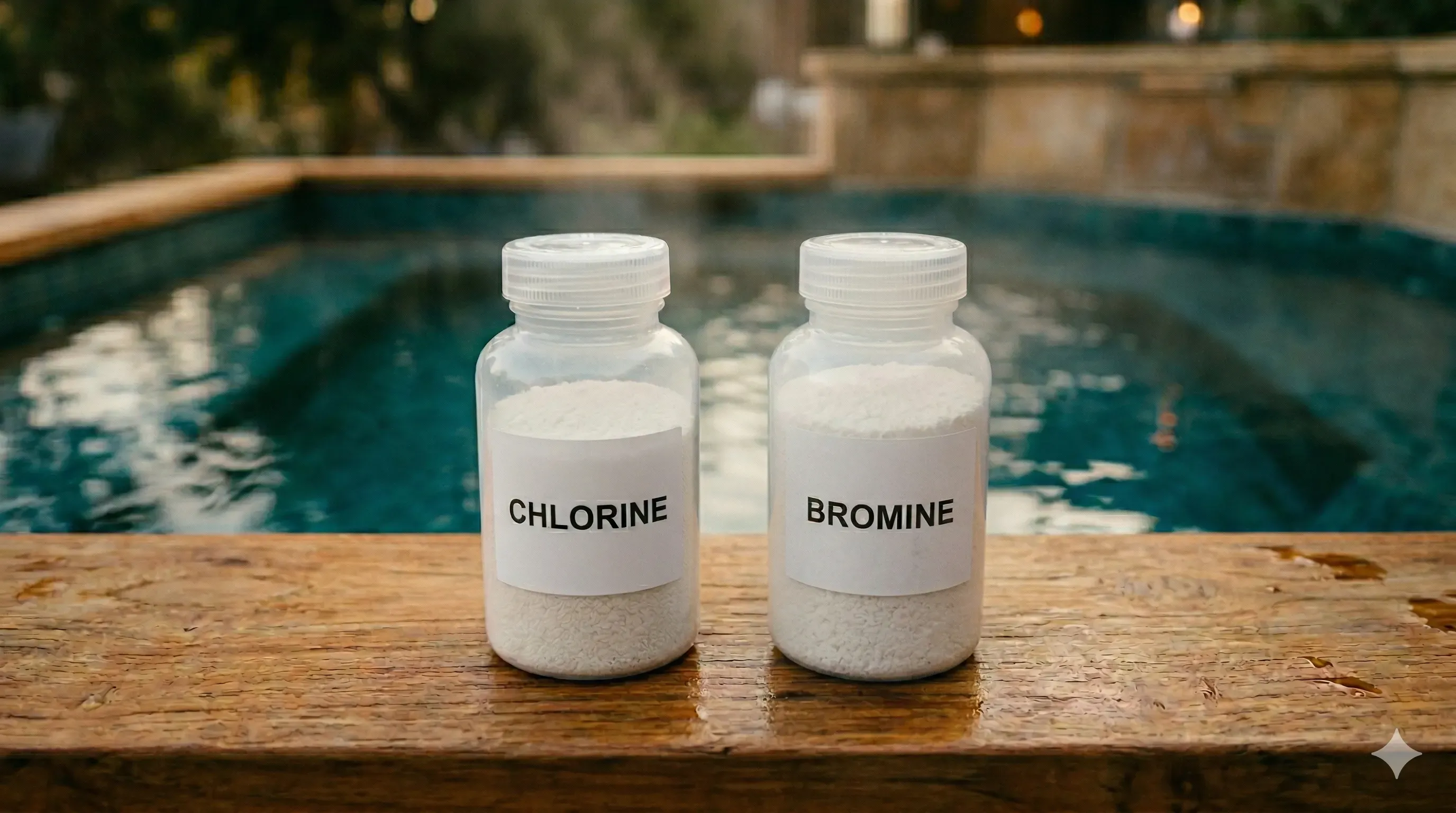
Every new hot tub owner lands on this question eventually. Both chlorine and bromine sanitize hot tub water. Both kill bacteria. Both require regular testing and maintenance. And both have vocal fans online who’ll tell you the other one is wrong.
The honest answer: neither is objectively better. They work differently, they feel different in the water, and one might suit your situation much better than the other. Here’s the real chemistry behind each one so you can pick the right system for your tub, your water, and your skin.
The quick comparison
| Chlorine (dichlor) | Bromine (BCDMH tablets) | |
|---|---|---|
| Form | Granules you sprinkle in | Tablets in a floating dispenser |
| Ideal range | 3 to 5 ppm free chlorine | 3 to 5 ppm bromine |
| pH effectiveness range | Best below 7.6 | Effective up to 8.0 |
| Stability at spa temps | Degrades faster in heat | More stable in heat |
| Odor | Stronger, especially as chloramines build | Milder, even as bromamines build |
| Skin irritation | Higher (chloramines are harsh) | Lower (bromamines are gentler) |
| UV stability | Protected by CYA | Degrades quickly in sunlight |
| Dosing method | Manual, every 1 to 2 days | Continuous, via dispenser |
| Startup complexity | Simple: sprinkle and test | Requires a bromide bank first |
How chlorine works in a hot tub
When you add dichlor granules to your hot tub, they dissolve and release hypochlorous acid (HOCl). That’s the molecule doing the actual killing. It works fast. At the right concentration and pH, chlorine wipes out most dangerous organisms within minutes. So far so good.
As chlorine reacts with organic contaminants (sweat, body oils, skin cells), it forms combined chlorine, also called chloramines. These are the compounds responsible for the harsh “pool smell” and the eye irritation people associate with chlorinated water. Chloramines are poor sanitizers. They linger. And they need to be destroyed through regular shocking.
Dichlor also adds cyanuric acid (CYA) with every dose, roughly 9 ppm of CYA for every 10 ppm of chlorine. CYA protects chlorine from UV degradation, which matters in outdoor pools exposed to sunlight. In a covered hot tub, CYA serves almost no purpose and accumulates into a real problem over time. Once CYA passes 50 ppm, it binds to free chlorine and slows its bacteria-killing speed, even when test strips show normal levels.
In practice, you add dichlor manually every one to two days, test regularly, and shock weekly. When CYA builds too high (usually every 2 to 3 drain cycles if using dichlor exclusively), you either drain to reset it or switch to the dichlor-then-bleach method, where you use dichlor for the first week or two after a refill and then transition to plain bleach for ongoing dosing. Bleach adds zero CYA.
How bromine works in a hot tub
Bromine sanitizes through a different chemistry. The active form is hypobromous acid (HOBr), which kills bacteria and oxidizes organic contaminants similarly to chlorine but with some important behavioral differences.
The pH advantage is the big one. Bromine’s effectiveness holds up across a much wider pH range than chlorine. Chlorine drops sharply above pH 7.6. At pH 8.0, free chlorine is only about 22% active. Bromine stays roughly 80% effective at that same pH. For a hot tub where pH tends to drift upward between tests, that tolerance matters. You get more consistent sanitation even when pH isn’t perfectly dialed in.
Bromine also handles its waste products better. When bromine reacts with organic waste it forms bromamines instead of chloramines. Unlike chloramines, bromamines retain some sanitizing ability and are far less irritating to skin and eyes. They produce less odor too. The “chemical smell” problem that plagues chlorine hot tubs? Largely absent with bromine.
And at spa temperatures (100°F to 104°F), bromine simply outlasts chlorine in the water. Heat chews through chlorine faster, which means more frequent dosing and more chances for your levels to bottom out between tests.
One real weakness: bromine has no equivalent of CYA to protect it from UV light. Direct sunlight breaks it down rapidly. This rarely matters for hot tubs with covers, but if you have an uncovered outdoor tub in full sun, chlorine with CYA handles that environment better.
How the bromide bank works. Bromine operates on a reserve system. You dissolve sodium bromide into the water at startup to create a reservoir of inactive bromide ions. Then you activate them into working bromine by adding an oxidizer (chlorine shock or MPS). As bromine does its job and gets “used up,” it reverts back to bromide. Shocking reactivates it again. The bank slowly depletes over time and needs periodic replenishment with more sodium bromide. The flip side is that when levels get too high, the bank makes it harder to lower bromine than most owners expect.
Bromine tablets (BCDMH) release both bromine and a small amount of chlorine as they dissolve, which keeps the bank activated continuously. Most bromine tub owners use a floating dispenser loaded with tablets and adjust the dispenser’s flow ring to control the release rate.
Where chlorine wins
Speed of kill. In ideal conditions (pH 7.4, adequate free chlorine), chlorine destroys bacteria faster than bromine. For a tub with perfectly managed water, chlorine is marginally more potent as a straight sanitizer.
Simplicity. Sprinkle granules, test, done. No bromide bank to establish, no floating dispenser to manage, no sodium bromide to reorder. Chlorine is straightforward, and that matters for people who want the simplest possible routine.
Availability. You can buy dichlor granules at any pool store, hardware store, or online retailer. Bromine tablets and sodium bromide are common enough but less universally stocked, especially at big box stores.
UV tolerance. If your tub gets direct sunlight (no cover, outdoor installation in full sun), CYA-stabilized chlorine resists UV breakdown far better than bromine. This is a narrow use case since most hot tubs have covers, but it’s real.
CYA management is solvable. The biggest knock on chlorine in a hot tub is CYA accumulation. But the dichlor-then-bleach method sidesteps this entirely after the first week of each fill cycle. If you’re willing to learn it, CYA stops being a concern. Most chlorine veterans consider it a non-issue.
Where bromine wins
pH forgiveness. This is bromine’s strongest practical advantage. Hot tubs drift toward higher pH naturally (outgassing CO2, jet aeration). Between tests, your pH might sit at 7.8 or 8.0 for a day. With chlorine, that means your sanitizer is working at half strength or less. With bromine, you’re still getting 80% effectiveness. In real-world conditions where pH isn’t always perfect, bromine provides more consistent protection.
Comfort. Bromamines are gentler than chloramines. People who experience skin dryness, red eyes, itching, or that “tight” feeling after soaking in a chlorine tub often find these symptoms disappear with bromine. If anyone in your household has sensitive skin or a chlorine sensitivity, bromine is worth trying.
Less odor. Even a well-maintained chlorine tub produces some chloramine smell between shocks. Bromine produces far less noticeable odor, both from the water and on your skin after soaking.
Temperature stability. At spa temperatures, bromine outlasts chlorine in the water. You get a more stable residual between doses, which means fewer surprise low readings.
No CYA accumulation. Bromine adds no cyanuric acid. Ever. There’s nothing to build up, no threshold to monitor, and no need to switch products mid-cycle. The water chemistry stays simpler over the life of each fill.
Reactivation. Used chlorine is spent and gone forever. Used bromine reverts to bromide and can be shocked back to life. You’re recycling your sanitizer, which honestly feels like the smarter chemistry once you understand it.
The daily routine compared
Chlorine routine:
- Test (30 seconds)
- Sprinkle dichlor if free chlorine is below 3 ppm (30 seconds)
- Adjust pH if needed (1 minute)
- Total active time: about 2 minutes, every 1 to 2 days
Bromine routine:
- Test (30 seconds)
- Check the floating dispenser (adjust flow if needed, replace tablets when low)
- Adjust pH if needed (1 minute)
- Total active time: about 2 minutes, every 1 to 2 days, with occasional tablet refills
The day-to-day effort is nearly identical. The difference is in the method: chlorine requires active dosing every time, while bromine uses a passive dispenser that releases continuously. Some people prefer the set-and-forget nature of the dispenser. Others like the hands-on control of dosing granules by test results.
Making the choice
There’s no wrong answer if you pick one and commit to it. But here’s a framework that matches each system to the owner it fits best.
Chlorine makes more sense if:
- You want the simplest startup process
- You’re comfortable dosing manually every couple of days
- Nobody in your household has skin sensitivity to chlorine
- Your tub is outdoors without a cover (UV exposure)
- You’re already experienced with chlorine from pool ownership
Bromine makes more sense if:
- Anyone soaking has sensitive skin, allergies, or reacts to chlorine
- You prefer a passive dosing system (floating dispenser)
- Your pH tends to run high and you don’t want to chase it constantly
- You want less chemical odor on your skin and around the tub
- You’d rather avoid the CYA management question entirely
Either one works fine if:
- Your water chemistry is reasonably balanced
- You test and maintain on a regular schedule
- You shock weekly regardless of which sanitizer you use
- You drain and refill on a regular cycle
The sanitizer type matters less than the consistency of the person managing it. A perfectly maintained chlorine tub beats a neglected bromine tub every time, and the reverse is equally true.
Can you switch from one to the other?
Yes. Drain the tub completely, refill with fresh water, and start the new system from scratch. Don’t try to convert by adding bromine products to chlorinated water or vice versa. The chemistries don’t blend well, and mixing creates bromochloramines that make the water harder to manage and more irritating to skin.
If you’re switching to bromine, your first step after refilling is dissolving sodium bromide (about 2 tablespoons per 100 gallons) to establish the bromide bank. Then activate it with a chlorine shock or MPS dose. From there, load your floating dispenser with BCDMH tablets and adjust the flow.
Switching from bromine to chlorine is simpler. Drain, refill, and start dosing dichlor as you would for any fresh fill.
Frequently asked questions
Is bromine or chlorine better for hot tubs? Neither is universally better. Chlorine (dichlor) is simpler to start, faster acting at ideal pH, and easier to find in stores. Bromine stays effective at higher pH and temperature, produces fewer skin and odor complaints, and adds no CYA. The best choice depends on your skin sensitivity, how closely you manage pH, and which dosing style you prefer.
Can you switch from chlorine to bromine in a hot tub? Yes, but drain and refill first. You can’t run both systems in the same water. After refilling, add sodium bromide to build the bromide bank, activate it with shock, then load your floating dispenser with bromine tablets. The transition takes about the same time as a normal drain-and-refill cycle.
Is bromine better for sensitive skin? For most people, yes. Bromamines are much less irritating than chloramines. If you get red eyes, dry skin, or itching from chlorine, bromine is worth trying.
Why does bromine cost more than chlorine? The tablets carry a higher price per pound. On top of that, you need a floating dispenser or inline brominator and sodium bromide to establish the bromide bank. Those extras add up at the start. The ongoing difference per month is real but not dramatic for a typical 300 to 400 gallon tub. Most owners who switch to bromine say the comfort improvement justifies the gap, though you should expect to spend noticeably more on product over the life of each fill cycle.
Does bromine work better in hot water than chlorine? At spa temperatures (100 to 104°F), bromine degrades more slowly than chlorine. It also maintains sanitizing power up to about pH 8.0, while chlorine’s effectiveness drops off above 7.6. Together, these advantages give bromine a more stable and forgiving performance profile in the warm, slightly-alkaline conditions that hot tubs naturally produce.
Do I still need to shock a bromine hot tub? Absolutely. Organic waste and bromamines build up the same way chloramines do. Weekly shocking with MPS (non-chlorine shock) is the standard routine. Chlorine shock works too and actually reactivates the bromide bank as a bonus. Shocking is part of hot tub ownership regardless of your sanitizer system.