The Dichlor Bleach Method for Hot Tubs: Step by Step
Use dichlor to build CYA, then switch to bleach forever. Here's the exact protocol with dosing charts, the science behind it, and how to troubleshoot.
The dichlor bleach method is the most discussed water care approach in the hot tub enthusiast community, and for good reason. It solves the biggest chemical problem in hot tub ownership: cyanuric acid buildup from dichlor slowly strangling your chlorine’s ability to sanitize.
You use dichlor for a few weeks to build a small CYA reserve. Then stop using dichlor forever and switch to plain liquid bleach, which delivers chlorine with zero CYA. Your chlorine stays effective, your water stays cleaner longer, and you extend the time between drains.
The CDC recommends against using CYA-containing chlorine products in hot tubs and spas. This method is the practical compromise: just enough CYA to protect chlorine from UV, then no more.
Why CYA is a problem in hot tubs
Dichlor is about 50% cyanuric acid by weight. Every time you add dichlor to sanitize, you’re adding almost as much CYA as chlorine. The chlorine gets consumed doing its job. The CYA stays. It doesn’t break down, evaporate, or filter out. It only leaves when you drain.
In a 400-gallon hot tub dosed with dichlor four times a week, CYA reaches 50 ppm in about four weeks and 100 ppm in seven weeks. That’s a problem because CYA binds to free chlorine and reduces its killing power.
At 30 ppm CYA, about 3% of your free chlorine is in the active form (hypochlorous acid) that kills bacteria. At 50 ppm, it’s roughly 1%. At 100 ppm, half a percent. Those numbers are brutal. You can have 5 ppm free chlorine on your test strip and still have water that can’t kill Pseudomonas fast enough to prevent hot tub rash.
The Trouble Free Pool community calls this “chlorine lock,” though it’s not a binary lock. It’s a sliding scale where chlorine gets weaker as CYA climbs. The only fix for high CYA is draining.
The method: phase by phase
Phase 1: Fresh fill and balance
Start with a fresh fill. If you haven’t purged the plumbing recently, do that first with Ahh-Some. Balance the water:
- Total alkalinity: 50 ppm (lower than the usual 80 to 120 recommendation, because lower TA slows pH drift from bleach and aeration)
- pH: 7.4 to 7.6
- Calcium hardness: 150 ppm
Phase 2: The dichlor phase (weeks 1 to 3)
Use dichlor granules as your sole chlorine source. Dose after each soak and as needed between soaks to maintain free chlorine at 3 to 5 ppm.
Dichlor dosing by tub size (to raise FC by about 5 ppm):
| Tub Size | Dichlor Amount |
|---|---|
| 300 gallons | 1.5 teaspoons |
| 400 gallons | 2 teaspoons |
| 500 gallons | 2.5 teaspoons |
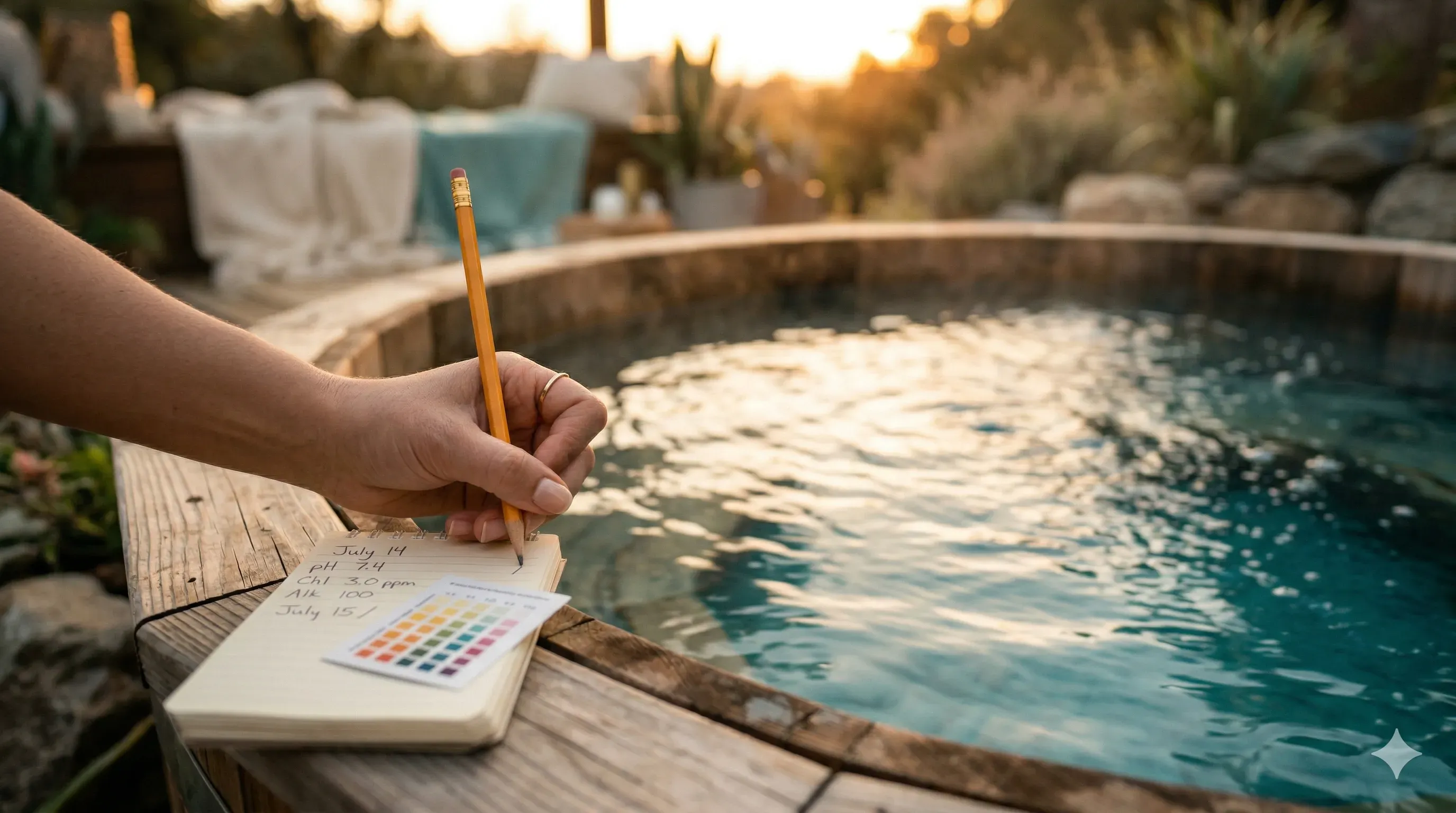
Test CYA weekly with a liquid test kit (not strips). Each dose of dichlor adds about 0.9 ppm CYA for every 1 ppm of chlorine.
Week-by-week CYA accumulation (400-gallon tub, 4 doses per week):
| Week | Approximate CYA |
|---|---|
| Week 1 | 9 ppm |
| Week 2 | 18 ppm |
| Week 3 | 27 ppm |
| Week 4 | 36 ppm |
Phase 3: The switch
When CYA reaches 30 ppm, stop using dichlor. Completely. Switch to plain, unscented liquid bleach for all chlorine going forward.
That’s when the method pays off. From here on, CYA stays put and every bleach dose adds pure chlorine with no stabilizer baggage.
Phase 4: Ongoing bleach maintenance
Dose bleach before and after each soak to maintain free chlorine at 3 to 5 ppm. Never let FC drop to zero between soaks.
Bleach dosing to raise FC by 1 ppm:
| Tub Size | 6% Bleach | 8.25% Bleach | 10% Pool Chlorine |
|---|---|---|---|
| 300 gal | 0.65 fl oz | 0.47 fl oz | 0.39 fl oz |
| 400 gal | 0.87 fl oz | 0.63 fl oz | 0.52 fl oz |
| 500 gal | 1.08 fl oz | 0.79 fl oz | 0.65 fl oz |
After a soak, the rule of thumb: about 3 to 5 fluid ounces of 8.25% bleach per person-hour of soaking in a 400-gallon tub at 104F. Two people soaking for 30 minutes: roughly 3 to 5 fluid ounces total.
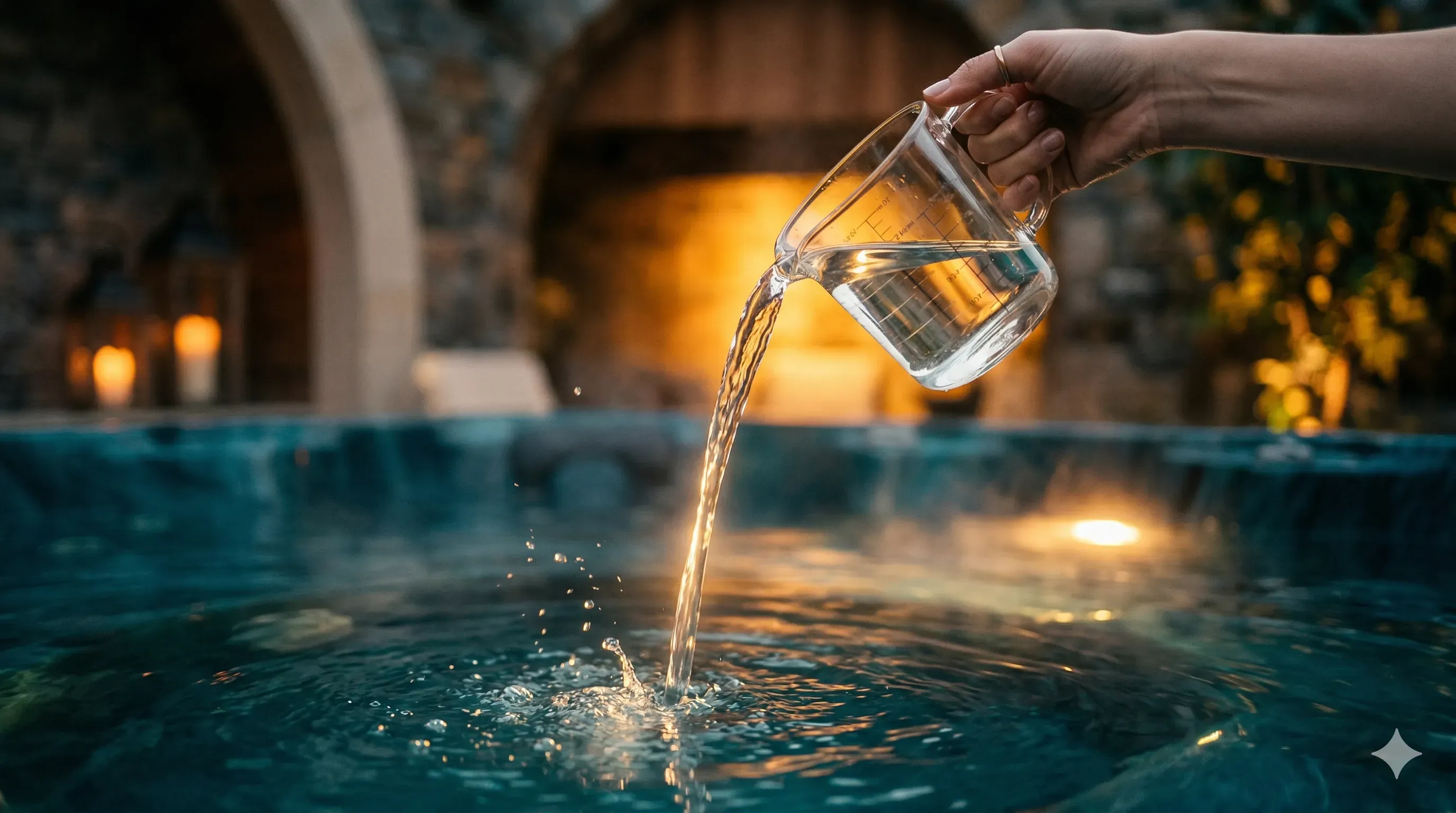
Add bleach with jets running so it distributes evenly. Test FC the next day and adjust. After a few weeks, you’ll know your tub’s pattern and dosing becomes automatic.
Phase 5: Borates for pH stability (optional but recommended)
Bleach has a pH of about 12.5. Every dose pushes pH up. Jet aeration drives off CO2, which also raises pH. Together, they make pH management the biggest ongoing task with this method.
The fix the Trouble Free Pool community uses: lower total alkalinity to 50 ppm and add 50 ppm borates (from boric acid). Borates act as a pH buffer at the hot tub pH range, dampening the upward drift. With this setup, many owners report adjusting pH with acid only every few days instead of daily.
What bleach to buy
The only rule: plain, unscented sodium hypochlorite with no additives. Check the ingredients. The label should list sodium hypochlorite and water. Nothing else.
Good options:
- Clorox Regular (8.25%)
- Store brand plain bleach (Great Value, Kirkland, generic) at 6% to 8.25%
- Pool-grade liquid chlorine (10% to 12.5%) from pool stores or Home Depot
Never use:
- Splashless or easy-pour bleach (contains surfactants that cause massive foaming)
- Scented bleach
- Bleach with fabric protection or other additives
- Gel or thick formulas
Storage matters. Bleach degrades over time, faster in heat. A bottle of 6% bleach loses about 20% of its strength in six months at room temperature. Pool-grade 12.5% degrades faster. Buy in quantities you’ll use within a month or two. Store in a cool, dark place. Never transfer to clear containers.
Troubleshooting
pH won’t stop rising. Your total alkalinity is probably too high. Lower it to 50 ppm using sodium bisulfate. Add 50 ppm borates if you haven’t already. The combination of low TA plus borates is what makes pH manageable on this method.
Chlorine disappears overnight. Either you’re underdosing (hot tub water at 104F consumes chlorine fast), or you have a biofilm issue in the plumbing consuming sanitizer around the clock. If you’re dosing correctly and FC still drops to zero by morning, purge the lines with Ahh-Some, drain, and start fresh.
CYA overshot the target. If CYA climbed past 50 ppm before you caught it, you have two options. Drain 30 to 50% of the water and refill to dilute CYA back to range. Or drain completely and start over. Partial drains are less disruptive.
Water is cloudy after switching to bleach. Usually a filtration issue, not a chemistry issue. Make sure your filter is clean and your filter cycle is long enough. Bleach itself doesn’t cause cloudiness.
You accidentally bought splashless bleach. If you added it once and foaming started, time and regular bleach additions will eventually break down the polymers. If you used it multiple times, drain and refill.
Who this method is for (and who should skip it)
Good fit: Owners who soak regularly (3 or more times per week), are comfortable testing water before and after soaks, want the cleanest possible water, and don’t mind a few minutes of maintenance each soak day. The Trouble Free Pool community calls this “the least expensive, safe, and sanitary way to manage a spa.”
Not a good fit: Owners who soak once a week or less (chlorine evaporates between uses and you’ll be dosing bleach into an empty tub just to maintain levels). Owners who want set-it-and-forget-it convenience (a bromine floater requires less daily attention). Owners who travel frequently (the method doesn’t run on autopilot; leave for four days and FC drops to zero).
The honest assessment: it’s more hands-on than bromine tabs in a floater, especially at first. You’re testing FC before every soak, adding bleach manually, and managing pH. After a month you’ll have the routine down and it becomes second nature. But if that sounds tedious, bromine or a salt system might suit you better.
The dichlor-only comparison
| Dichlor Only | Dichlor/Bleach Method | |
|---|---|---|
| CYA behavior | Keeps rising, forces a drain every 2 to 3 months | Capped at 30 ppm, stays stable |
| Chlorine effectiveness | Degrades as CYA climbs | Stays consistent |
| Water change interval | Every 2 to 3 months | Every 4 to 6 months |
| pH management | Minimal (dichlor is near-neutral) | More active (bleach raises pH) |
| Daily effort | Scoop granules, test occasionally | Measure bleach, test FC, dose acid |
| Product cost | Higher (dichlor is more expensive per dose) | Lower (bleach is commodity priced) |
| Water quality | Declines as CYA builds | Stays high throughout |
Frequently asked questions
What is the dichlor bleach method? A two-phase hot tub sanitization approach. You use dichlor granules for the first few weeks to build a cyanuric acid base of 30 ppm, then permanently switch to plain liquid bleach for all ongoing chlorine. Bleach adds zero CYA, so levels stay controlled. You only use dichlor again after the next drain and refill.
When do I switch from dichlor to bleach? When your CYA test reads 30 ppm. This usually takes 3 to 4 weeks of regular dichlor use in a 400 gallon tub. You need a liquid test kit like the Taylor K-2006 to measure CYA accurately. Test strips aren’t reliable enough for this measurement.
How much bleach do I add to my hot tub? For a 400 gallon tub with 8.25% bleach, about 0.63 fluid ounces raises free chlorine by 1 ppm. After a typical soak with 2 people for 30 minutes, add about 3 to 4 fluid ounces to replenish what was consumed. Always test before and after.
Does bleach damage hot tub acrylic or equipment? No. Once dissolved, bleach produces the same hypochlorous acid as dichlor. The active sanitizer in the water is identical regardless of source. The concern about bleach damage stems from pouring concentrated bleach directly on surfaces, which you should avoid. Add it to the water with jets running.
Why does my pH keep rising with the bleach method? Two reasons. Bleach has a pH of 12.5, and hot tub jets drive off dissolved CO2 through aeration, which also pushes pH up. The fix is lowering total alkalinity to about 50 ppm and adding 50 ppm borates. This combination slows pH drift enough that you only need acid every few days instead of daily.
Can I skip dichlor and go straight to bleach? For outdoor tubs, a small amount of CYA (20 to 30 ppm) protects chlorine from UV degradation when the cover is off. You could add granular CYA directly instead of using dichlor to build it, but dichlor is more convenient since it sanitizes and adds CYA simultaneously. For indoor tubs with no sun exposure, some owners skip CYA entirely.