How to Balance Total Alkalinity in Your Hot Tub
Alkalinity controls whether your pH stays put or drifts all day. This guide covers testing, raising, lowering, and stabilizing it with exact dosing by tub size.
If your pH won’t stay put, alkalinity is almost always the reason. You add pH decreaser, it drops, and by tomorrow it’s right back where it was. Or you can’t get pH to budge no matter how much product you throw at it. Both problems trace back to the same number: total alkalinity.
Alkalinity is the least understood measurement in hot tub chemistry, and it’s the one that makes everything else work. Get it right and pH behaves itself. Get it wrong and you’ll spend weeks chasing numbers that never stick.
What total alkalinity actually is
Total alkalinity (TA) measures the concentration of bicarbonate and carbonate ions dissolved in your water. Those ions act as a buffering system, absorbing acids and bases before they can move your pH.
Think of it this way. pH tells you where your water sits on the acid/base scale right now. Alkalinity tells you how hard it is to push that number around. Water with good alkalinity shrugs off small chemical additions and stays stable. Water with low alkalinity overreacts to everything.
When you add an acid (like pH decreaser or a dose of dichlor), the bicarbonate ions absorb the acid’s hydrogen ions before they can crash the pH. When a base enters the water, bicarbonate releases hydrogen ions to neutralize it. The more bicarbonate available, the more acid or base the water can absorb before pH actually shifts. That’s the buffer.
TA is measured in parts per million (ppm). For hot tubs, the sweet spot is 80 to 120 ppm.
What your alkalinity should be
The industry standard recommendation is 80 to 120 ppm, and for most hot tub owners that’s the right target. Inside that range, your water has enough buffering to keep pH stable but not so much that pH gets locked in place and resists adjustment.
Some experienced owners on the Trouble Free Pool forums intentionally run alkalinity lower, in the 50 to 80 ppm range. The logic: hot tub jets constantly aerate the water, which drives off CO2 and pushes pH upward. Lower alkalinity means less buffering, so pH rises more slowly, and you need less acid to correct it. If you’re adding pH decreaser every few days, dropping your TA target to around 70 ppm can cut that in half.
Both approaches work. The standard 80 to 120 range is the safe, universal recommendation. The lower range requires more confidence in your testing and a willingness to monitor more closely.
Below 50 ppm is where problems start. pH will swing wildly with every chemical addition, every soak, every temperature change. That’s called pH bounce, and it makes everything else in your water chemistry unpredictable.
Above 150 ppm, the opposite happens. pH locks high and resists adjustment. You’ll add acid and nothing moves. The water feels sluggish and tends toward cloudiness and scale buildup.
How to raise alkalinity
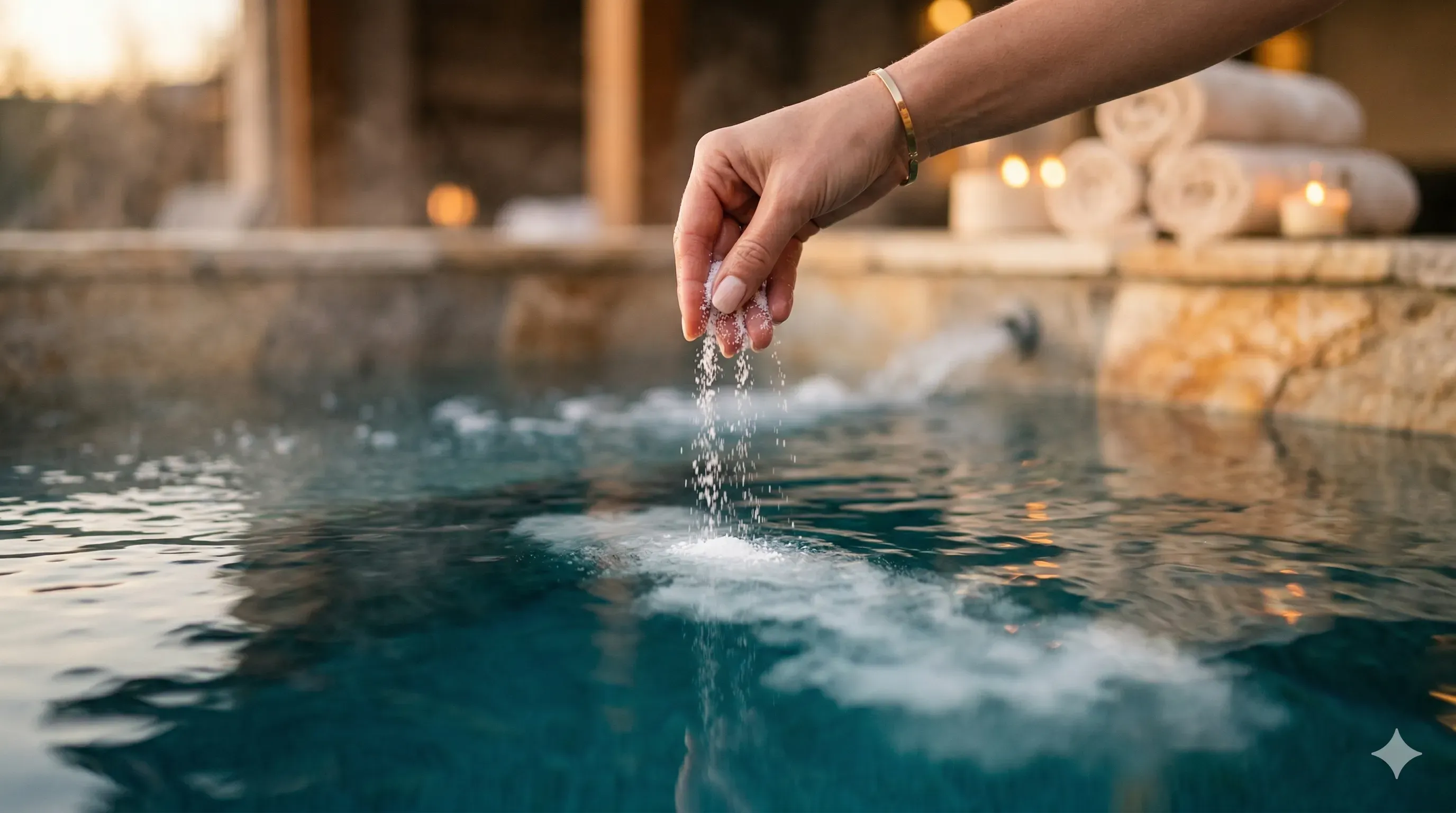
Sodium bicarbonate. That’s it. It’s sold under the name “alkalinity increaser” at pool stores, and it’s the exact same compound as baking soda from the grocery store. Same chemical formula, same effect, different label.
Dosing by tub size (to raise alkalinity by 10 ppm):
| Tub Size | Amount of Baking Soda |
|---|---|
| 200 gallons | 2 tablespoons |
| 300 gallons | 3 tablespoons |
| 400 gallons | 4 tablespoons |
| 500 gallons | 5 tablespoons |
How to add it:
- Test your current alkalinity level
- Calculate how much you need based on the table above
- Pre-dissolve the baking soda in a bucket of warm water (prevents clumping)
- Pour the dissolved solution into the hot tub with jets running
- Let it circulate for at least 30 minutes
- Wait 3 to 6 hours before retesting
Don’t try to make a big correction in one shot. If alkalinity is at 50 and you want 100, add enough for a 20 ppm bump, wait, retest, and add more. Smaller steps are always safer than overshooting and then having to lower it.
One note: raising alkalinity also raises pH slightly. Always adjust alkalinity first, get it where you want it, and then fine tune pH afterward.
How to lower alkalinity
The chemical you need is sodium bisulfate, sold as “pH decreaser” or “dry acid” at any pool supply store. It lowers both pH and alkalinity at the same time.
Dosing: About 1 tablespoon of sodium bisulfate per 100 gallons lowers alkalinity by roughly 10 ppm. Start there, wait four to six hours, retest, and repeat if needed. Most corrections take two to three rounds.
Don’t use muriatic acid in a hot tub. It works in pools, but in a 300 to 500 gallon tub it’s dangerously concentrated, produces acid fumes in the enclosed spa environment, and can damage acrylic surfaces, seals, and equipment. Multiple manufacturers warn against it. Sodium bisulfate is safer, easier to dose, and does the job.
The acid and aerate technique
Here’s the problem: sodium bisulfate lowers both pH and alkalinity. Sometimes you need to lower alkalinity but your pH is already fine or even a bit low. The acid and aerate method solves this by letting you lower alkalinity selectively.
- Add acid. Dose sodium bisulfate to drop both pH and alkalinity. Let pH fall to about 7.0 (lower than you’d normally want).
- Aerate the water. Turn jets on high, open all air valves, and leave the cover off. If you have an air blower, run it. You can also point a return jet upward to break the water surface.
- Wait. Aeration causes dissolved CO2 to escape from the water. CO2 is acidic (it forms carbonic acid), so losing it makes the water less acidic. pH rises back up.
- Here’s the trick: pH rises, but alkalinity does not. The bicarbonate you consumed with the acid is gone. You’ve selectively removed alkalinity while recovering pH through a completely different mechanism.
- Repeat as needed. Each cycle lowers alkalinity a bit more. It takes patience. Two or three cycles over a few days is normal for a significant reduction.
Honestly, this technique is the best method for dealing with stubbornly high alkalinity, especially when you fill from hard tap water that comes in at 150 ppm or above.
The four alkalinity and pH mismatch scenarios
You test both numbers, one or both is off, and you don’t know what to fix first. This section is the one people bookmark.
High alkalinity, high pH (the most common scenario)
Everything is high. Water feels slippery. Scale starts forming on the heater and jets. pH decreaser barely makes a dent because high alkalinity buffers against every correction.
Fix: Use the acid and aerate technique above. Add acid to drop both numbers, then aerate to recover pH. Each cycle brings alkalinity down while pH bounces back up. Two to three rounds usually gets both numbers into range.
High alkalinity, low pH (less common)
This happens when you’ve been adding a lot of acid to fight pH drift without realizing you’re also slamming alkalinity down and then overshooting on the acid side. Or your sanitizer is very acidic (bromine tablets run a pH around 3.6) and you’ve been using too much.
Fix: Stop adding acid. Aerate to bring pH up. The high alkalinity will buffer pH upward once you stop fighting it. If alkalinity is above 150, use the acid and aerate technique after pH recovers, but stop acid additions until pH is back to at least 7.4.
Low alkalinity, high pH
This seems contradictory, but it’s common with heavy jet use. Jets drive off CO2, which pushes pH up. Meanwhile, your acidic sanitizer (dichlor or bromine) has been consuming alkalinity with every dose. Low alkalinity means there’s no buffer to resist the upward drift, so pH climbs freely.
Fix: Add baking soda to raise alkalinity. Once the buffer is back in place, pH usually settles down on its own. If pH is still high after alkalinity reaches 80 to 100 ppm, add a small dose of sodium bisulfate.
Low alkalinity, low pH
The most straightforward scenario. Both numbers are depressed, usually from overuse of acid or from a sanitizer that’s been eating through the buffer over time.
Add baking soda. It raises both alkalinity and pH at the same time. One product, both problems solved. Easiest fix on this whole list.
Why alkalinity keeps drifting
If you’re constantly correcting alkalinity, something in your routine is consuming it. The most common culprits:
Your sanitizer. Dichlor has a near-neutral pH (6.5 to 7.0), but it’s still acidic enough to chip away at alkalinity over time. For every 10 ppm of free chlorine you add from dichlor, alkalinity drops by about 3.5 ppm. That doesn’t sound like much, but over weeks of regular dosing it adds up. Bromine tablets are even more aggressive, running a pH around 3.6, and they deplete alkalinity faster than dichlor.
pH decreaser. Every time you add sodium bisulfate to lower pH, you’re also lowering alkalinity. If you’re dosing acid frequently because pH keeps climbing (which often means alkalinity is too high in the first place), you’re caught in a cycle where the cure is part of the problem.
Your fill water. Tap water varies a lot by region. Some municipal and well water sources have naturally low bicarbonate levels. If your fill water starts at 40 ppm alkalinity, you’ll need to bump it up after every drain and refill. Others come in at 200+ ppm and you’ll be fighting it down. Test your tap water once so you know your starting point.
Age of the water. After months in the tub, the water accumulates dissolved solids, sanitizer byproducts, and organic waste that make chemical adjustments less predictable. If alkalinity used to stay stable and now won’t, and you’ve been topping off for months without draining, the water might just be exhausted. Time for a fresh fill.
How alkalinity, pH, and calcium interact
These three parameters are connected through something water chemistry professionals call the Langelier Saturation Index (LSI). You don’t need to calculate it yourself, but understanding the concept helps.
The LSI tells you whether your water is corrosive (dissolving surfaces and equipment) or scale-forming (depositing minerals on everything).
Higher pH, higher alkalinity, higher calcium hardness, and higher temperature all push the water toward scaling. Lower values push it toward corrosion. Hot tubs already run at 100 to 104F, which biases the water toward scaling from the start. This is why you can’t just crank alkalinity and calcium to the top of their ranges and call it done. A tub at 104F with alkalinity at 120, calcium at 250, and pH at 7.8 will scale aggressively. The same tub at alkalinity 80, calcium 150, and pH 7.4 stays balanced.
The practical takeaway: if your hard water pushes calcium up, consider keeping alkalinity on the lower end of the 80 to 120 range to compensate. The three numbers work together.
Frequently asked questions
What should total alkalinity be in a hot tub? Between 80 and 120 ppm. This range gives your water enough buffering to keep pH stable without locking it in place. Some experienced owners run 50 to 80 ppm to reduce pH drift from jet aeration, which is fine as long as pH stays steady.
What is the difference between alkalinity and pH? pH measures how acidic or basic your water is right now. Alkalinity measures your water’s ability to resist pH changes. Think of alkalinity as a shock absorber for pH. Without enough alkalinity, pH bounces wildly with every chemical addition or soak.
Can I use baking soda to raise alkalinity in my hot tub? Yes. Baking soda is sodium bicarbonate, the exact same chemical sold as alkalinity increaser at the pool store. One tablespoon per 100 gallons raises alkalinity by about 10 ppm. The branded product costs three to five times more for the same thing.
How do I lower alkalinity without lowering pH? Add sodium bisulfate to lower both alkalinity and pH, then run the jets on high with air valves open to aerate the water. Aeration raises pH back up through CO2 outgassing without restoring the alkalinity you removed. Repeat the cycle until alkalinity reaches your target.
Why does my alkalinity keep dropping? Dichlor and bromine tablets are both acidic and consume alkalinity with every dose. If you use either sanitizer regularly without adding baking soda periodically, alkalinity will gradually decline until pH becomes unstable. Test weekly and bump it up when it drops below 80 ppm.
Should I adjust pH or alkalinity first? Alkalinity first, always. Alkalinity is the buffer that holds pH in place. If you correct pH while alkalinity is out of range, the pH will drift right back within a day. Get alkalinity to 80 to 120 ppm, wait a few hours, then fine tune pH.