Hot Tub Test Strips: How to Test, Read, and Fix Your Water
Test strips tell you what's happening in your water, but only if you use them right. Here's how to test, interpret results, and know when strips aren't enough.
You can’t fix what you can’t measure. Every chemical decision in your hot tub starts with a test. Bad test, bad dosing, wasted product, water that won’t cooperate. Most hot tub owners reach for test strips, and honestly, that’s fine for everyday monitoring. They’re fast and cheap and they’ll tell you if something is wildly off. But strips have real limits that catch people off guard, and understanding those limits saves you from chasing numbers all week when one good reading and one adjustment would’ve done it.
What test strips actually measure
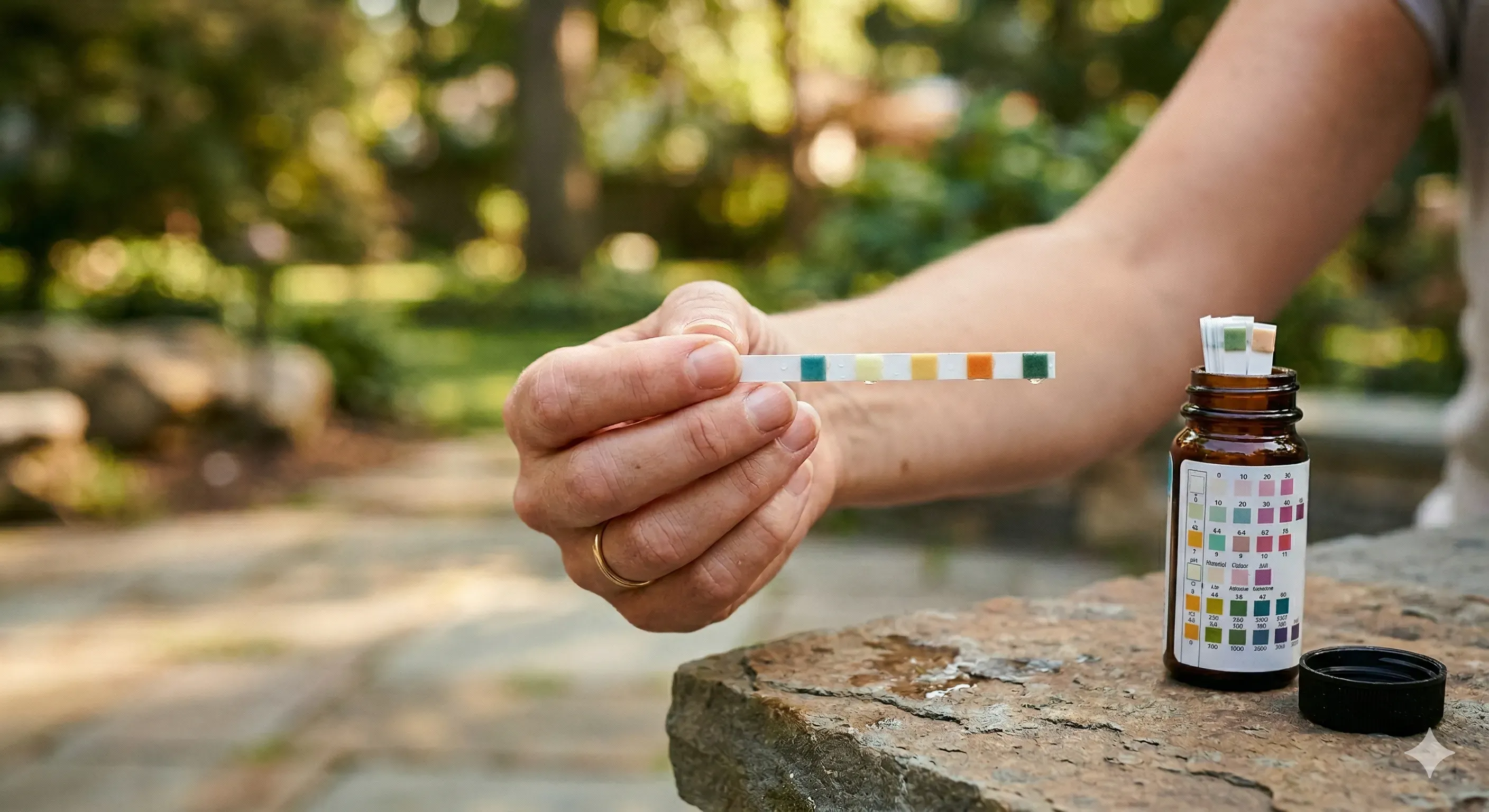
A standard 6-in-1 spa test strip has six small pads, each soaked with a chemical reagent that changes color when it contacts your water. You dip the strip, wait a few seconds, and compare the colors to a chart on the bottle. The pads test for:
- Free chlorine (or bromine): your active sanitizer level
- pH: how acidic or basic the water is
- Total alkalinity: the buffering capacity that keeps pH stable
- Total hardness: calcium and magnesium concentration
- Total chlorine: free chlorine plus combined chlorine (chloramines)
Seven-way strips add a cyanuric acid (CYA) pad. That pad exists, but it’s the least reliable reading on the strip by a wide margin. More on that below.
What standard strips don’t measure at all: metals (copper, iron), total dissolved solids (TDS), phosphates, and salt levels. If you need any of those, you need specialized strips, a digital meter, or a professional test.
How to test correctly
Small details change your readings more than you’d expect. Here’s the method that gives consistent results:
- Dry your hands completely. Moisture on your fingers activates the reagent pads before the strip touches spa water. That ruins the test before it starts.
- Dip at elbow depth, away from jets. Surface water and water near return jets aren’t representative. Go a few inches below the waterline, away from dispensers and returns.
- In and out in one to two seconds. Don’t swirl or soak. A quick dip is all the pads need.
- Hold the strip level with pads facing up. Tilting lets colors bleed between pads and gives you crossover readings.
- Read at the exact time specified by your brand. For most strips, that’s 15 seconds after dipping. Reading early means the reaction hasn’t finished. Reading late means the colors have drifted past the calibrated point.
- Compare colors in natural daylight. Indoor lighting, especially warm LEDs or incandescent bulbs, shifts how colors appear. Don’t wear sunglasses while matching.
Two rules that matter more than people realize: never touch the reagent pads with your fingers, and close the bottle cap immediately after pulling a strip. Humidity degrades the remaining strips in an open bottle fast.
Common mistakes that give bad readings
Testing right after adding chemicals. Chlorine, pH adjuster, and alkalinity increaser all need time to circulate and dissolve. Wait at least 30 minutes with jets running before retesting. After a heavy shock dose, wait two to four hours.
Storing strips in the hot tub cabinet. That cabinet is warm and humid, which is exactly what degrades reagent pads. Store strips indoors at room temperature, dry, with the cap sealed tight.
Using expired strips. Check the date on the bottle. Strips past their expiration give faded, ambiguous colors. If you can’t tell whether your pH is 7.2 or 7.8, the strip might be the problem, not the water.
The bleaching trap. Almost nobody talks about this one, and it’s the mistake most likely to cause real harm. When free chlorine gets very high (above 10 ppm), it bleaches the DPD reagent on the chlorine pad. The pad turns white instead of pink. It reads zero. You see zero, assume you need chlorine, and add more. The actual level climbs higher while the strip keeps reading zero. If your chlorine reads zero but you recently added a heavy dose, dilute your water sample 50/50 with plain tap water and retest. If the diluted sample shows chlorine, the original was too high, not too low.
High chlorine throwing off pH readings. When free chlorine is above 5 ppm, it can interfere with the pH reagent pad, making pH read higher than it actually is. If your pH suddenly reads 8.0+ right after shocking, that might be chlorine interference rather than a real pH spike. Wait for chlorine to drop below 5 ppm, then retest pH.
How to read your results and what to do next
Here’s where every other testing guide stops. They show you how to match colors and call it done. But matching colors is step one. The part that actually matters is knowing what those numbers mean together and what to do about them.
Your target ranges:
| Parameter | Ideal Range | What happens if too low | What happens if too high |
|---|---|---|---|
| Free chlorine | 3 to 5 ppm | Bacteria thrive, water turns cloudy | Skin and eye irritation, bleaches swimwear |
| pH | 7.4 to 7.6 | Corrosion, skin stinging, chlorine overly aggressive | Scale buildup, sanitizer loses power, slippery water |
| Total alkalinity | 80 to 120 ppm | pH bounces wildly with every chemical addition | pH locks high and resists adjustment |
| Calcium hardness | 150 to 250 ppm | Foam, aggressive water that etches surfaces | Scale on heater, jets, and plumbing |
Always fix alkalinity before pH. This is the single most important sequencing rule in hot tub chemistry. Alkalinity is the buffer that holds pH steady. If alkalinity is out of range and you adjust pH, it’ll drift right back within a day. Get alkalinity to 80 to 120 ppm first, wait a few hours, then fine tune pH.
When chlorine reads zero but you’ve been dosing. Don’t automatically add more. First, rule out the bleaching trap (dilute and retest). If it truly is zero, something is consuming chlorine: biofilm in the plumbing, high CYA from months of dichlor use, or a heavy organic load from lotions and oils. Adding more chlorine without fixing the root cause just burns through product.
When pH is high but alkalinity is low. This sounds contradictory, but it happens. Aeration from jets drives off CO2, which pushes pH up. Meanwhile, your sanitizer (especially dichlor) has been consuming alkalinity with every dose. Fix alkalinity first with baking soda, and the pH situation often corrects itself.
When test strips aren’t enough
Strips work fine for a daily sanity check. “Am I roughly in range?” is the question they answer. But when you need to troubleshoot, strips hit a wall.
Resolution. Forget accuracy for a second. The bigger issue is that strips read in coarse jumps between values:
| Parameter | Strip readings | Liquid kit readings |
|---|---|---|
| Free chlorine | 0, 0.5, 1, 3, 5, 10 ppm | 0.2 ppm increments |
| pH | 6.2, 6.8, 7.2, 7.8, 8.4 | 0.2 unit increments |
| Total alkalinity | 0, 40, 80, 120, 180, 240 ppm | 10 ppm increments |
Look at chlorine: there’s nothing between 1 and 3. If your actual level is 2 ppm, you’re guessing. Look at pH: the jump from 7.2 to 7.8 covers your entire target range with zero resolution inside it. And alkalinity has a 60 ppm gap between 120 and 180. You can’t calculate a dosing adjustment from a range that wide.
A liquid test kit like the Taylor K-2006 or the TF-100 uses drop-count titration. For chlorine, you add reagent drops to a sample until the color changes from pink to completely clear. Each drop equals 0.2 ppm. Seeing a color disappear is far easier than matching shades of pink on a chart, and you get a specific number instead of a range.
CYA buildup. Here’s the one that catches dichlor users off guard. If you use dichlor (the most common hot tub granular chlorine), you need to track cyanuric acid. Dichlor is about 50% CYA by weight. Every 10 ppm of chlorine you add from dichlor also adds about 9 ppm of CYA. In a typical hot tub, CYA can hit 50 ppm in four weeks and 100 ppm in seven weeks of normal dosing.
Why this matters: CYA locks up chlorine. At 100 ppm CYA, you’d need 7 to 8 ppm free chlorine just to match the killing power of 3 ppm at 30 ppm CYA. High CYA is one of the top reasons hot tubs won’t hold chlorine.
CYA pads on test strips are notoriously unreliable. Documented cases show strips reading zero CYA when liquid kits measured over 100 ppm. Hot tub water temperatures above 90F make CYA strips read even lower than actual. If you use dichlor, a liquid test kit with the turbidity (disappearing dot) CYA test is the only way to track this.
Upgrade to a liquid kit if you’re dealing with any of these:
- Persistent cloudy water or sanitizer demand you can’t resolve
- You use dichlor and haven’t tracked CYA in months
- Your strip results keep contradicting each other
- pH adjustments won’t hold despite proper dosing
- You want to calculate combined chlorine (chloramines)
The Taylor K-2006 and TF-100 are the two kits the Trouble Free Pool community recommends. Both use Taylor reagents and the FAS-DPD method. The TF-100 comes with about 36% more reagent and a broader pH range. Either one is a genuine upgrade from strips.
Digital testers. They sound appealing because they eliminate color matching. In practice, they’ve been a letdown. The LaMotte ColorQ can’t measure free chlorine above 10 ppm, making it useless for high dose situations. Smart monitors like Sutro and pHin have both shut down. The LaMotte SpinTouch is what pool stores use, and Trouble Free Pool members have documented getting three different results from the same water sample tested three times. A drop-count liquid kit remains more reliable than any consumer digital device.
Pool store testing. Bring a sample to three stores and you’ll likely get three different results with three different chemical recommendations. Store tests use professional equipment, but accuracy depends on calibration, operator training, and the inherent conflict of interest: stores profit from selling you chemicals. One well-documented case showed a store reporting CYA at 113 ppm when the actual level was 65 ppm, then recommending over 30 pounds of product. Use store testing as a second opinion, not your primary method.
How often to test
| Situation | What to test | How often |
|---|---|---|
| Normal maintenance | Sanitizer and pH | 2 to 3 times per week |
| Heavy use week or multiple bathers | Sanitizer and pH | Before every soak |
| After adding chemicals | Whatever you adjusted | 30 minutes after dosing |
| After shocking | Sanitizer and pH | 2 to 4 hours after |
| First week after a fresh fill | Full panel | Daily until stable |
| Alkalinity and calcium hardness | Both | Weekly |
| CYA (if using dichlor) | CYA with liquid kit | Monthly |
The pattern that works best: test before you soak. It takes 15 seconds with a strip and tells you whether your water is ready. If something is off, you can dose and let it circulate while you get ready. Testing reactively, only after something looks or smells wrong, means you’re always behind. By the time water looks cloudy, chemistry has been off for days.
Keep a simple log. Date, sanitizer, pH, what you added. After two weeks of notes, you’ll see patterns. Maybe pH drifts every three days. Maybe alkalinity stays rock solid but chlorine drops after heavy weekend use. Patterns let you dose proactively instead of reactively. That’s less work, fewer chemicals, and better water. Your testing routine is the foundation of your entire maintenance schedule.
Frequently asked questions
Are hot tub test strips accurate? They’re accurate enough for routine monitoring but not for troubleshooting. Strips read in broad jumps, like showing chlorine at 1 or 3 with nothing in between. A liquid test kit like the Taylor K-2006 reads in 0.2 ppm increments, which matters when you’re trying to dial in a specific level.
How often should I test my hot tub water? Test free chlorine or bromine and pH two to three times per week. Test alkalinity and calcium hardness weekly. Test before every soak if you can, and always retest 30 minutes after adding chemicals to confirm adjustments landed where you wanted them.
Why does my test strip show zero chlorine after I just added some? Two possibilities. Either something in your water is consuming chlorine faster than you can add it, like biofilm, high CYA, or heavy organic load. Or the chlorine is actually very high and has bleached the test pad, causing it to read zero. Dilute the sample with tap water and retest to check.
Do hot tub test strips expire? Yes. Reagent pads degrade from moisture, heat, and age. Most strips are reliable for about two years from manufacture. After the expiration date, colors become faded and readings drift. Always check the date and store strips at room temperature with the cap tight.
What is the difference between free chlorine and total chlorine? Free chlorine is the active sanitizer available to kill bacteria right now. Total chlorine includes both free chlorine and combined chlorine, which are chloramines that have already reacted with contaminants and lost their killing power. The difference between total and free is your combined chlorine level.
Should I use test strips or a liquid test kit? Start with strips for daily monitoring. They’re fast and convenient for confirming you’re in the right ballpark. But if you’re troubleshooting a persistent problem, tracking CYA buildup from dichlor, or getting inconsistent results, upgrade to a Taylor K-2006 or TF-100 liquid kit for accurate numbers you can act on.