How Much Chlorine to Add to Your Hot Tub (By Size)
Exact dichlor and bleach dosing amounts by tub size, with a reference chart for every time you add chlorine. Covers maintenance and shock doses.
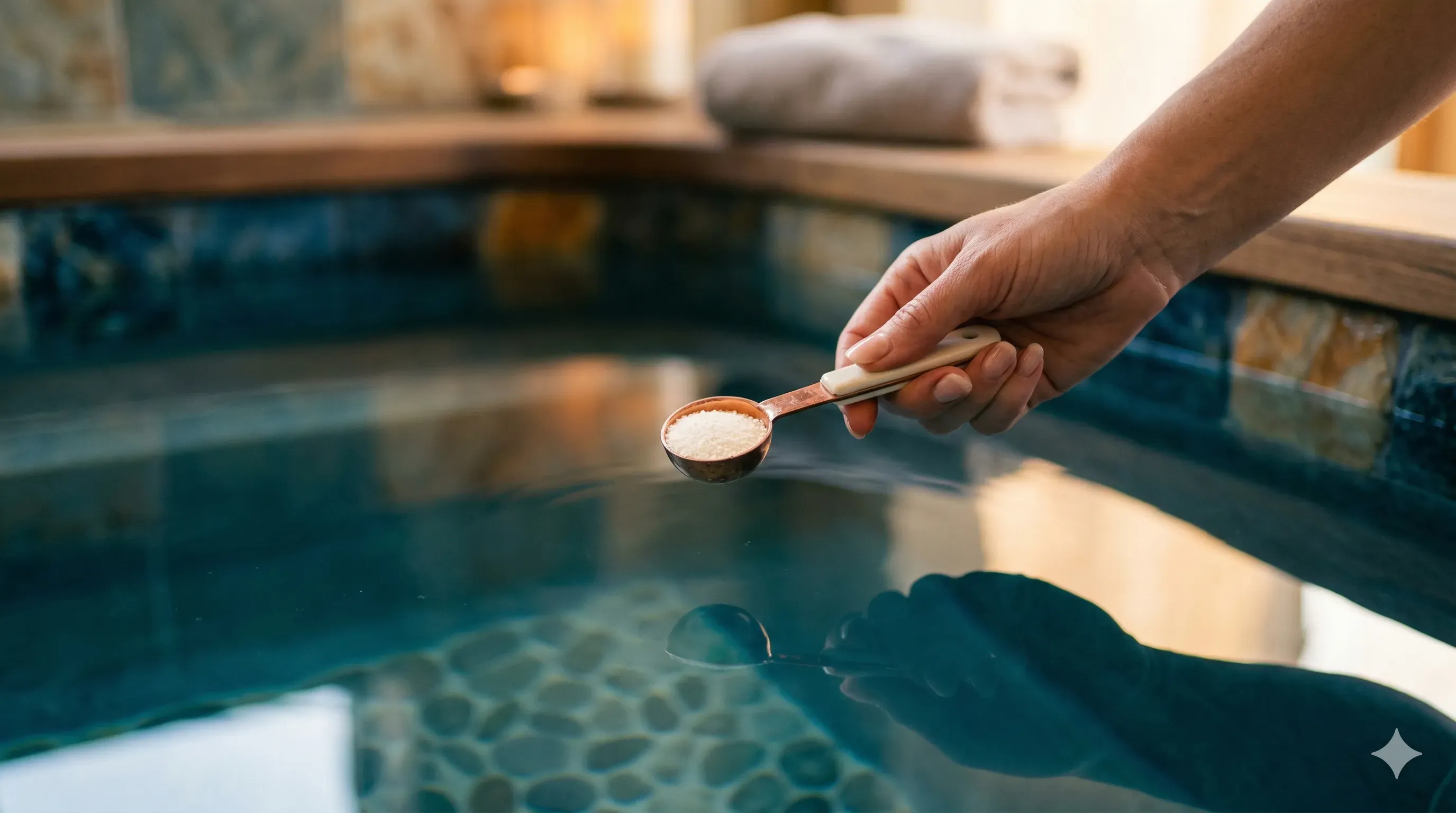
Every hot tub owner eventually stands over the water with a measuring spoon and thinks: how much of this stuff do I actually put in? The target range for free chlorine (3 to 5 ppm) is printed on every bottle and blog post on the internet. What nobody tells you is how many teaspoons of product it takes to get there in your specific tub.
That ends here. Below is a dosing chart by tub size that you can reference every time you add chlorine.
The quick answer
For routine maintenance with dichlor granules (56% available chlorine, the standard hot tub product), add 1/4 to 1/2 teaspoon per 100 gallons. That raises free chlorine by roughly 1 to 3 ppm, which is enough to top off a tub that’s already in range after a soak.
If your chlorine is at zero and you need to bring it up to target, use 1 teaspoon per 100 gallons to raise free chlorine by about 5 ppm.
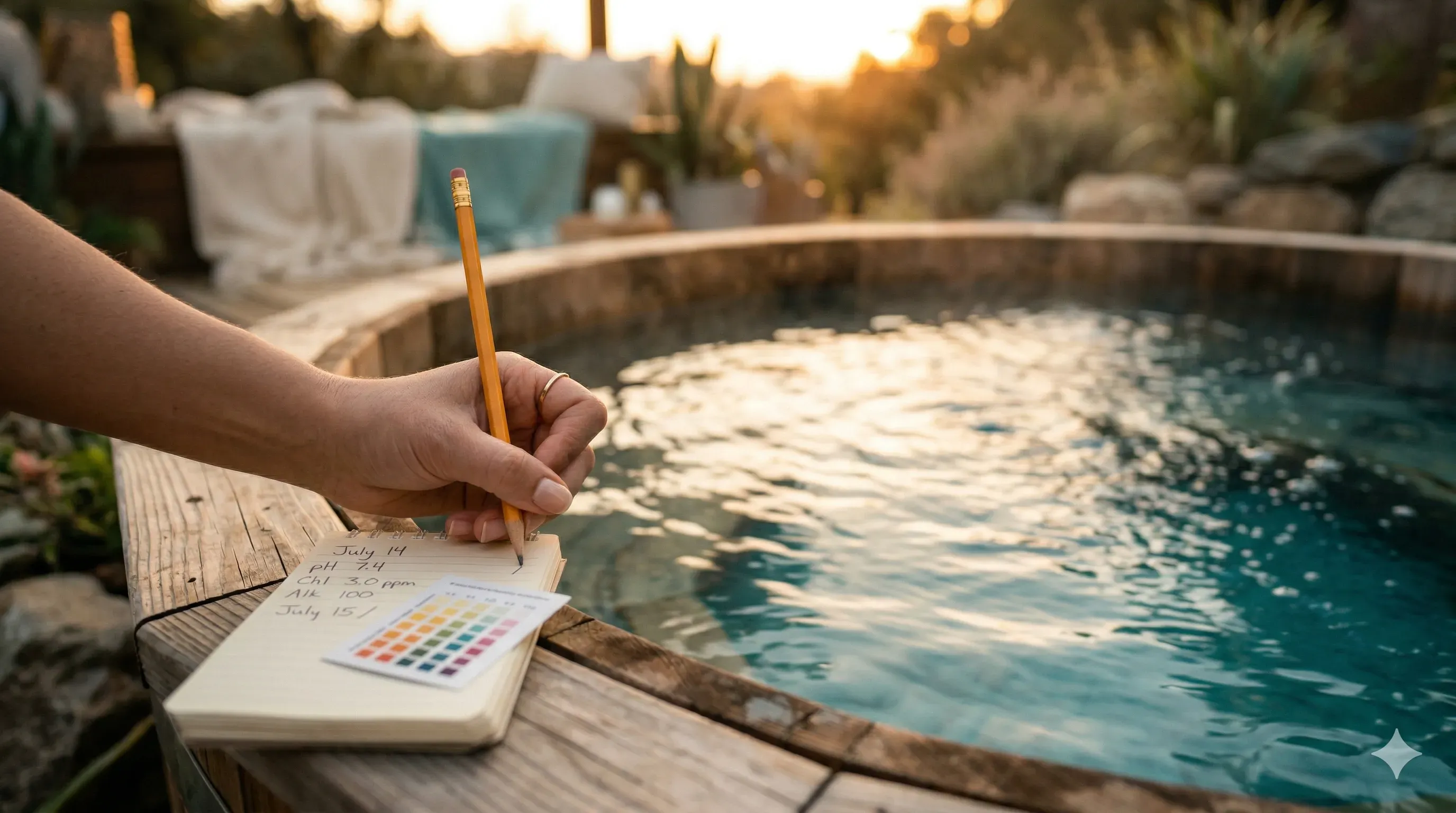
Test before you dose. Test 20 minutes after. Adjust from there.
Dichlor dosing chart by tub size
These numbers assume 56% sodium dichlor granules, the product sold as “chlorinating granules” or “chlorinating concentrate” at any pool supply store. Starting from near zero free chlorine.
Routine dose (raises FC by ~2 to 3 ppm):
| Tub Size | Dichlor Amount |
|---|---|
| 200 gallons | 1/4 to 1/2 teaspoon |
| 300 gallons | 1/2 to 3/4 teaspoon |
| 400 gallons | 3/4 to 1 teaspoon |
| 500 gallons | 1 to 1 1/4 teaspoons |
Moderate boost (raises FC by ~5 ppm):
| Tub Size | Dichlor Amount |
|---|---|
| 200 gallons | 2 teaspoons |
| 300 gallons | 3 teaspoons |
| 400 gallons | 4 teaspoons |
| 500 gallons | 5 teaspoons |
Shock dose (raises FC to ~10 ppm from a 2 ppm baseline):
| Tub Size | Dichlor Amount |
|---|---|
| 200 gallons | 3 to 4 teaspoons |
| 300 gallons | 5 to 6 teaspoons |
| 400 gallons | 7 to 8 teaspoons |
| 500 gallons | 9 to 10 teaspoons |
For a full guide on when and why to shock, see how to shock your hot tub.
How the math works
One teaspoon of 56% dichlor granules weighs roughly 5 to 6 grams. At 56% available chlorine, that’s about 3 grams of actual chlorine. Dissolved in 100 gallons of water, those 3 grams raise free chlorine by approximately 5 ppm.
Scale up from there. A 400 gallon tub needs four times the product for the same ppm increase. Simple multiplication.
The reason the “routine dose” range in the chart above is lower (1/4 to 1/2 teaspoon per 100 gallons) is that you’re usually topping off from 1 or 2 ppm, not dosing from zero. You don’t need a full 5 ppm boost after a casual soak. You need enough to push chlorine back into the 3 to 5 ppm range.
How much chlorine per soak
Soaking depletes chlorine. How much depends on how many people, how long, and what they bring into the water (lotions, sweat, cosmetics, hair products).
A useful rule from the spa chemistry community: every person-hour of soaking in a 104 degree tub consumes roughly 3 to 5 ppm of free chlorine. One person soaking for 30 minutes might use 1 to 2 ppm. Two people soaking for an hour could burn through 5 ppm or more.
That’s why you should dose after every soak, not on a fixed schedule. The amount you need depends entirely on how the tub was used.
After a light soak (one or two people, 20 to 30 minutes): 1/4 to 1/2 teaspoon per 100 gallons.
After heavy use (four people, an hour, somebody wore sunscreen): 1 teaspoon per 100 gallons, possibly more. Test and adjust.
After a party: Just shock it. Raise FC to 10 ppm using the shock chart above and let it work overnight.
Pre-soak habits make a huge difference. If everyone showers first and skips the body lotion, your chlorine demand drops noticeably. If people jump in after a day at the beach wearing sunscreen, you’ll burn through chlorine fast.
Fresh fill dosing
When you fill a hot tub for the first time or after a drain and refill, the chemistry sequence matters.
- Balance alkalinity first (80 to 120 ppm)
- Then adjust pH (7.4 to 7.6)
- Then add calcium if your fill water is below 150 ppm
- Then dose chlorine to 5 to 8 ppm (use 1 to 1.5 teaspoons of dichlor per 100 gallons)
- Wait 15 to 20 minutes between each chemical
Fresh tap water often has its own chlorine demand from dissolved organics and metals. Don’t be surprised if your first dose gets eaten up quickly. Retest after an hour and dose again if free chlorine dropped below 3 ppm.
Bleach dosing chart
If you’re using the dichlor/bleach method (and you probably should be after the first couple of weeks), here are the amounts for regular unscented 8.25% household bleach.
Routine maintenance (raises FC by ~3 to 5 ppm):
| Tub Size | Bleach Amount |
|---|---|
| 200 gallons | 1 to 2 tablespoons |
| 300 gallons | 2 to 3 tablespoons |
| 400 gallons | 3 to 4 tablespoons |
| 500 gallons | 4 to 5 tablespoons |
Shock dose (raises FC to ~10 ppm):
| Tub Size | Bleach Amount |
|---|---|
| 200 gallons | 3 to 4 tablespoons |
| 300 gallons | about 1/4 cup |
| 400 gallons | about 1/3 cup |
| 500 gallons | about 1/2 cup |
Bleach has a pH of about 12.5, so it pushes pH upward with every dose. You’ll need to adjust pH more often when using bleach compared to dichlor. Keeping alkalinity at the lower end of the 80 to 120 ppm range helps offset this.
One important thing about bleach: it degrades. A bottle that’s been sitting in a hot garage for six months has lost a significant portion of its strength. Buy it fresh, use it within a few weeks, and don’t stockpile.
The cyanuric acid factor
Dichlor is a great hot tub sanitizer, but it has a hidden cost. Every dose adds cyanuric acid (CYA) to your water. For every 10 ppm of chlorine you add through dichlor, CYA rises by about 9 ppm.
AQUA Magazine documented the math: a 300 gallon hot tub adding 1.5 teaspoons of dichlor four times a week can build CYA to 50 ppm in four weeks and 100 ppm in seven weeks.
Why that matters: CYA slows chlorine down. At CYA of 30 ppm, your chlorine works well at 3 to 5 ppm. At CYA of 50, you need at least 4 ppm just to match that same killing power. At CYA above 100, the chlorine in your water is functionally useless at any comfortable level. The CDC recommends against using CYA in spas at all, though a small amount (20 to 30 ppm) protects outdoor tubs from UV breakdown.
The dichlor/bleach method solves this. Use dichlor for the first week or two after a fill to build CYA to about 30 ppm. Then switch to plain unscented bleach for all ongoing dosing. Bleach adds chlorine without adding any CYA. For a deeper explanation of why this works, see our dichlor vs trichlor comparison.
If your CYA has already climbed past 50 ppm, no amount of chlorine will fix it. The only solution is to drain some or all of the water and start fresh.
pH changes everything
You can nail the dosing perfectly and still have weak sanitation if your pH is off.
At pH 7.4, about 53% of your chlorine is in its active form (hypochlorous acid). At pH 8.0, that drops to 22%. Same chlorine reading on the test strip, vastly different killing power.
Always check pH before adding chlorine. If pH is above 7.6, bring it down first. Otherwise you’re adding sanitizer that’s mostly sitting idle.
What not to use
Two products that look like hot tub chlorine but aren’t:
Trichlor tablets. These are pool pucks with a pH of 2.8. They dissolve slowly, dump acid into a small volume of water, and add CYA at a rate that overwhelms a hot tub in weeks. They corrode heaters, etch shells, and destroy seals. Never use them.
Calcium hypochlorite (cal-hypo). Pool shock with 65 to 73% available chlorine. Sounds strong, but it adds calcium to your water. In a hot tub running at 100 to 104 degrees, that extra calcium turns into scale on your heater and jets. Stick with dichlor or bleach.
When chlorine is too high
If you test and free chlorine is above 10 ppm, don’t get in the tub. Leave the cover off with the jets running on high. Sunlight, heat, and aeration all help chlorine dissipate. It will come down on its own.
At 10 ppm, it usually takes a few hours to drop below 5. At 20 ppm (after a heavy shock), give it 4 to 8 hours. Test before soaking, every time.
If you need the tub ready faster, sodium thiosulfate (“chlorine neutralizer”) instantly reduces free chlorine. Use it sparingly and in tiny amounts because overshooting leaves you with zero sanitizer.
Frequently asked questions
How many teaspoons of chlorine do I put in my hot tub? For dichlor granules, start with 1/4 to 1/2 teaspoon per 100 gallons for a routine maintenance dose. That raises free chlorine by about 1 to 3 ppm. If you need a bigger boost, 1 teaspoon per 100 gallons raises it roughly 5 ppm. Always test before and after.
How often should I add chlorine to my hot tub? After every soak and at least two to three times per week, even if nobody uses it. Bacteria multiply at hot tub temperatures whether people are in the water or not. Test first, dose to bring free chlorine back to 3 to 5 ppm, then retest 20 minutes later.
Can you put too much chlorine in a hot tub? Yes. Free chlorine above 10 ppm causes skin and eye irritation. If you overdose, leave the cover off with jets running. Chlorine will off-gas and drop on its own. Don’t soak until it reads below 5 ppm.
How much bleach do I add to my hot tub? For 8.25% unscented household bleach, use 2 to 3 tablespoons per 300 gallons to raise free chlorine by 3 to 5 ppm. Only use plain, unscented bleach with no additives. Never use splashless or scented varieties.
What is the difference between dichlor and bleach for hot tubs? Both add chlorine. Dichlor is granular, dissolves fast, and has a near neutral pH, but it also adds cyanuric acid with every dose. Bleach is liquid, adds zero cyanuric acid, but has a pH around 12.5. Most experienced owners start with dichlor and switch to bleach once cyanuric acid reaches 30 ppm.
How long after adding chlorine can I use my hot tub? Wait until free chlorine drops below 5 ppm. For a normal maintenance dose, that’s usually 15 to 20 minutes with jets running. After a heavy shock to 10 or 20 ppm, wait 4 to 8 hours. Always test before getting in.