How Often Should You Drain Your Hot Tub? The Real Answer
The standard advice is every 3 to 4 months. The real answer depends on how you use it. We cover the formula, the warning signs, and when to drain early.

The standard answer is every 3 to 4 months. You’ll find that number on every manufacturer website, in every owner’s manual, and across every hot tub blog on the internet. And for average use, it’s a reasonable starting point.
But “average use” covers a huge range. A couple who soaks twice a week isn’t the same as a family of four who uses the tub daily. The water in the first scenario might last five months. The water in the second might be done in six weeks.
Here’s how to figure out your actual schedule.
The drain formula
Gallons divided by daily bathers divided by 3 = days between drains.
Some real examples:
| Tub Size | Usage | Formula | Drain Every |
|---|---|---|---|
| 400 gallons | 2 people daily | 400 / 2 / 3 | ~67 days (2 months) |
| 400 gallons | 2 people, 3x/week | 400 / 0.86 / 3 | ~155 days (5 months) |
| 300 gallons | 4 people daily | 300 / 4 / 3 | 25 days (monthly) |
| 500 gallons | 1 person, 4x/week | 500 / 0.57 / 3 | ~292 days (9+ months) |
For irregular use, convert to an average daily number. If two people soak three times a week, that’s 6 person-sessions per week, divided by 7 = about 0.86 daily bathers for the formula.
The formula gives you a starting estimate. Treat it as a ceiling, not a guarantee. Inflatable tubs with smaller volumes (150 to 300 gallons) and weaker filtration typically need more frequent changes than the formula suggests. Several other factors the formula ignores can shorten the interval.
What the formula doesn’t account for
Pre-soak habits. Whether bathers shower first changes everything. Lotions, deodorant, cosmetics, and sunscreen introduce organic compounds that the formula assumes at some average level. If guests jump in straight from the yard wearing sunscreen, your water accumulates contaminants faster than the formula predicts.
Source water quality. If your fill water already has elevated total dissolved solids, you’re starting from a higher baseline. Hard water, well water with metals, or municipal water with high mineral content all shorten the useful life of your fill. The formula treats all fill water as equal. It isn’t.
Chemical accumulation. Every dose of sanitizer, pH decreaser, alkalinity increaser, and shock adds dissolved solids to the water. Cyanuric acid from dichlor is the most persistent because it never breaks down on its own. After weeks of dosing, CYA can reach 50 ppm or higher, at which point chlorine stops working well regardless of what the test strip shows.
Evaporation plays a role too. It removes water but leaves dissolved solids behind. Each time you top off, you’re adding fresh minerals to a shrinking concentration of useful water chemistry. Frequent top-offs without draining accelerate the buildup.
The signs that water is done
The formula tells you when to plan for a drain. These signs tell you when the water is asking for one right now, regardless of the schedule.
Chemistry stops responding. You add pH decreaser and pH barely moves. You shock and chlorine disappears within hours. Alkalinity won’t hold. When total dissolved solids pass a tipping point, the water becomes too saturated for chemical adjustments to work predictably. No amount of product fixes this. Only fresh water resets it.
The water looks dull. Test strips say everything is in range, but the water has a grayish or yellowish tint instead of that clear, bright look fresh water has. That’s dissolved organic waste that oxidation alone can’t remove. Your eyes are seeing what the test strip can’t measure.
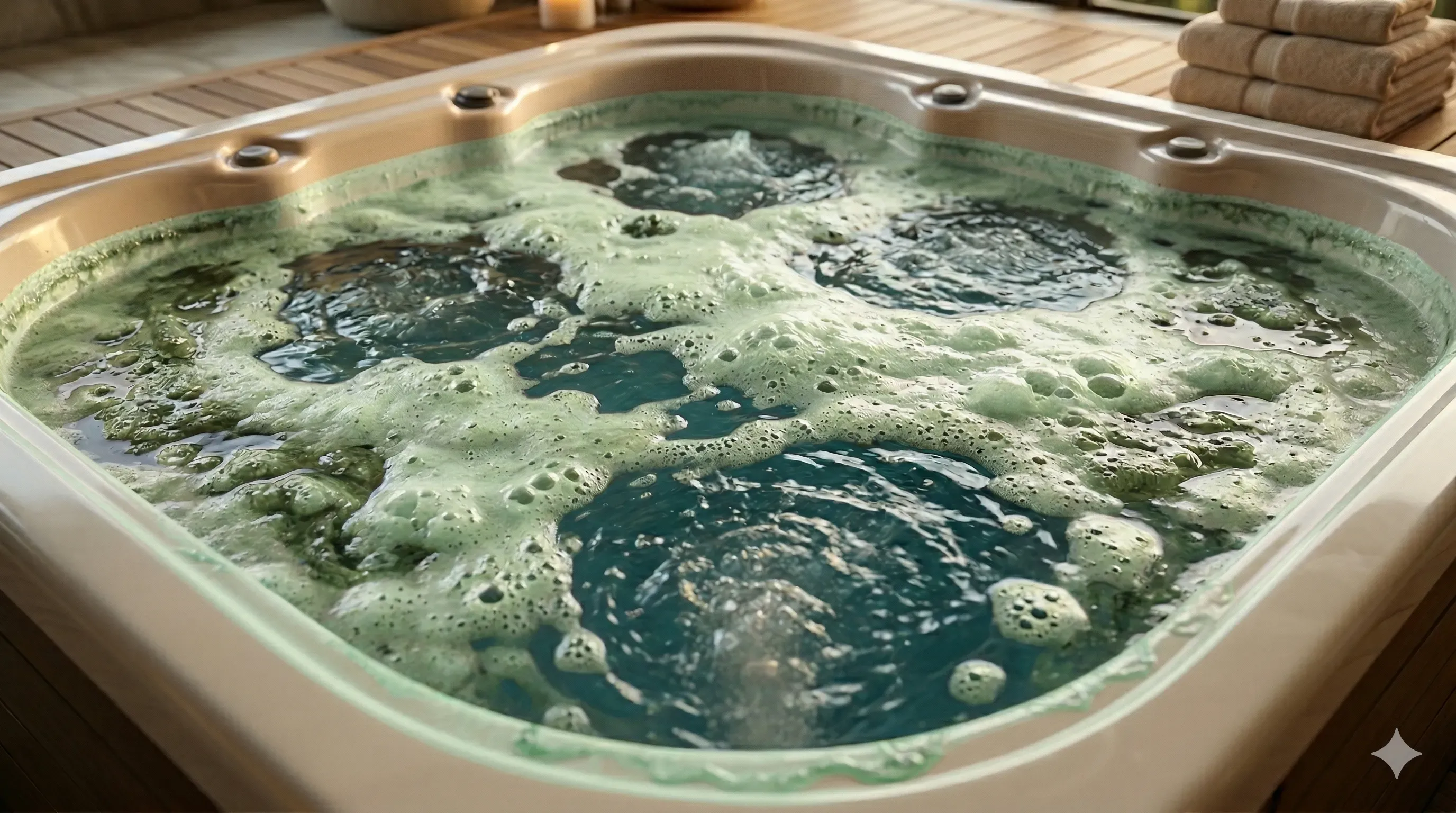
Foam that keeps returning is another signal. Some foam after heavy use is normal and dissipates with shocking. Foam that keeps returning, especially thick foam that covers the surface when jets run, means the water is loaded with surfactants from body oils, lotions, and detergent residue on swimsuits. Defoamer masks the symptom but doesn’t fix the cause.
Unusual smells. Not the sharp chloramine smell (which means you need more oxidation, not less), but something musty, earthy, or stale. That points to biofilm in the plumbing or organic buildup in the water that shocking can’t reach.
Sanitizer demand that climbs week over week. If you’re adding more chlorine each time just to maintain 3 to 5 ppm, the water is consuming sanitizer faster because there’s more dissolved waste competing for it.
Skin irritation after soaking. If the water stings, itches, or leaves skin red even with pH and sanitizer in range, the accumulated dissolved solids may be the irritant. Fresh water and a clean start usually resolve it immediately.
The TDS benchmark
Total dissolved solids (TDS) give you a number to back up what your eyes and nose are telling you. A TDS meter costs a few dollars and takes 10 seconds to use.
Your fill water has a baseline TDS. Municipal water runs around 200 to 400 ppm. Well water varies widely. Once the TDS in your hot tub exceeds your source water by about 1,500 ppm, the water is reaching the end of its useful life. Above that delta, chemistry becomes erratic and sanitizer effectiveness drops.
You don’t need to test TDS weekly. But if you’re wondering whether to drain or try one more round of chemical adjustments, a TDS reading gives you a concrete answer instead of guessing.
Always purge before you drain
Draining removes the water. It doesn’t remove the biofilm coating the inside of your plumbing. If you drain and refill without purging, the old biofilm inoculates the fresh water within days, and you’re back to fighting the same chlorine demand and cloudiness.
Run a plumbing purge product (Ahh-Some at about 1 tablespoon per 250 gallons) in the old water before draining. Jets on high for 20 to 30 minutes. You’ll see the gunk come out. Then drain, clean the shell, and refill clean.
Make purging a non-negotiable part of every drain cycle. Not optional. Not occasional. Every time.
Don’t drain in freezing weather
Empty plumbing in freezing temperatures cracks. Water left in lines, jets, and the pump after draining expands when it freezes and causes damage that’s expensive to repair and rarely covered by warranty.
The safe threshold is above 40 degrees Fahrenheit. If you’re draining in late fall or early spring, check the forecast first. The process takes a few hours start to finish, and you need the temperature to stay above freezing until the tub is refilled and heating.
If you plan to shut the tub down for winter instead of draining and refilling, you’ll need to winterize it with antifreeze, blown-out lines, and a secured cover. That’s a separate process from a routine drain.
A practical annual schedule
For a 400 gallon tub used by two people three to four times a week, a realistic annual cadence looks like this:
Late March: Drain, purge, clean, refill. Good weather for outdoor work.
Late June or early July: Second drain. Summer heat means more evaporation, more top-offs, more chemical buildup. Heavy use during warm months shortens the interval.
October: Third drain before winter settles in. Get fresh water and a clean plumbing system before cold weather makes outdoor maintenance less appealing.
January (optional): If you soak frequently through winter, a mid-winter drain keeps chemistry manageable during the season when most people use the tub the most. If your tub sits mostly idle in winter, you can push this to the March drain.
Adjust based on your usage. If chemistry starts fighting you before the next scheduled drain, don’t wait. The water is telling you it’s done. Fresh water and two hours of your time is always cheaper than weeks of extra chemicals trying to save dying water.
Frequently asked questions
How often should you change hot tub water? Every 3 to 4 months under normal use. The formula: divide your tub’s gallons by the average number of daily bathers, then divide by 3. A 400 gallon tub used daily by 2 people should be drained about every 67 days. Heavy use shortens the window.
What happens if you don’t drain your hot tub? Total dissolved solids accumulate from chemicals, body oils, sweat, and minerals. Eventually the water becomes saturated and stops responding to chemical adjustments. Chlorine demand climbs, water looks dull even with good test results, and biofilm gets a stronger foothold in the plumbing. Draining resets all of it.
Can you go a year without draining a hot tub? Only with advanced water care systems like salt water generators, which can push water life to 6 to 12 months with careful maintenance. Standard chlorine or bromine systems accumulate too much cyanuric acid, total dissolved solids, and biofilm to last a full year. Most owners see chemistry problems well before the 6 month mark.
Should I drain my hot tub for the winter? Only if you plan to stop using it entirely. If you’ll keep soaking through winter, keep it running, heated, and maintained as usual. If you’re shutting it down, drain it, purge the plumbing, blow out the lines, and winterize. Never let water sit idle in a cold tub without circulation and sanitizer.
How do I know when my hot tub water needs changing? Chemistry that won’t stabilize, persistent foam that shocking doesn’t fix, a dull or grayish water appearance despite good test readings, musty or earthy odors, and chlorine that disappears overnight are all signals. If you’re fighting the water instead of maintaining it, drain and start fresh.