Inflatable Hot Tub Chemical Setup for Beginners
Inflatable tubs need smaller doses, more frequent testing, and different rules than permanent spas. Exact dosing charts by model and volume inside.
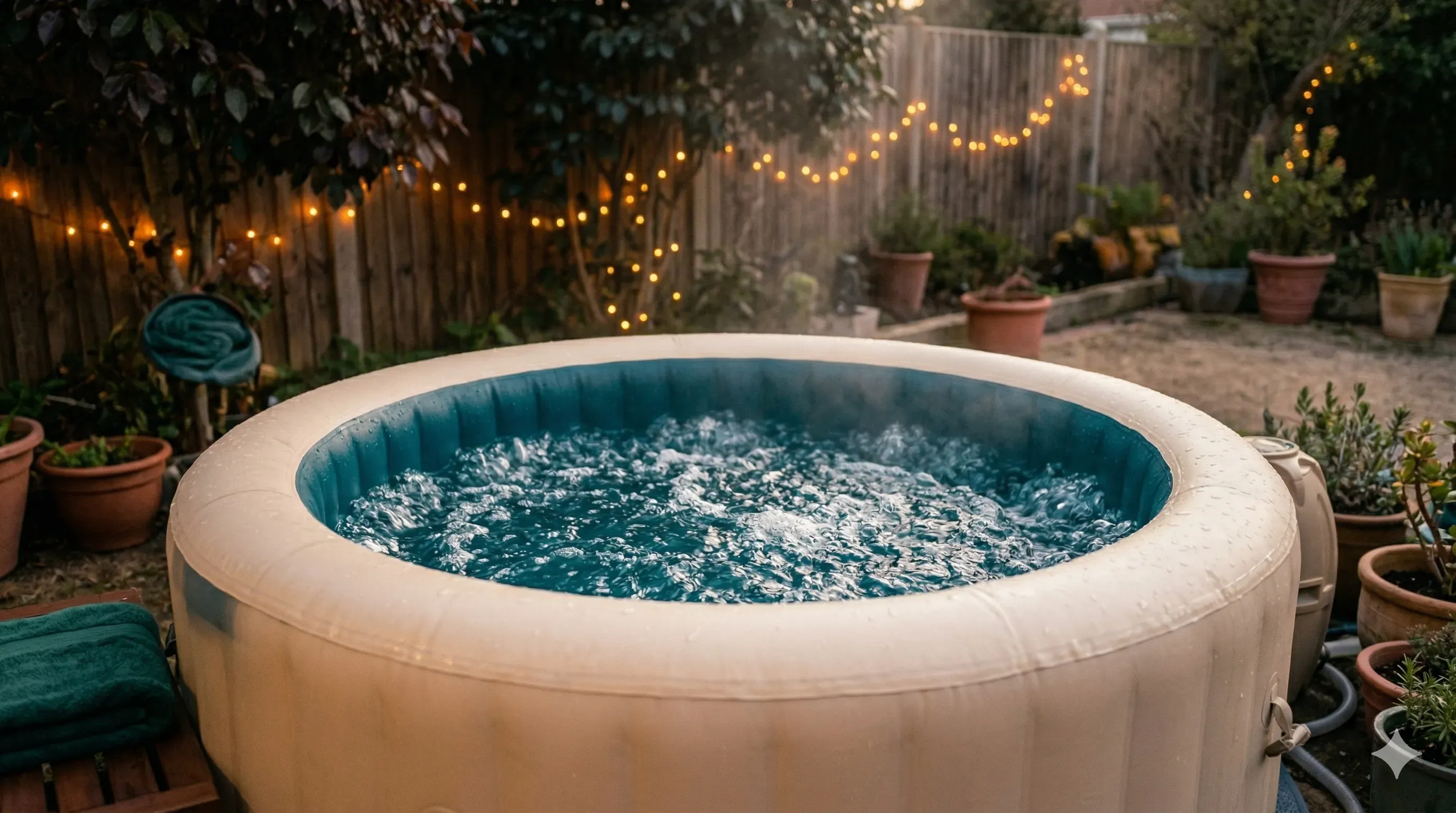
Inflatable hot tubs outsell permanent spas in most markets now, but almost every chemical guide online was written for 400 gallon acrylic tubs with ozone generators and dedicated circulation pumps. Apply that advice to a 200 gallon vinyl tub with a single filter cartridge and you’ll bleach the liner before the first month is over.
That’s why this guide only covers inflatables. The rules are different enough that copying permanent-spa advice will cost you a liner.
What makes inflatable tubs different
Before touching a single chemical, you need to understand why your Intex, Bestway, or Coleman tub behaves differently than the permanent spas that most guides are written for.
Most inflatable tubs hold 150 to 300 gallons. A standard permanent spa holds 350 to 500. That sounds close, but the chemistry impact isn’t linear. A teaspoon of pH decreaser that barely moves the needle in a 450 gallon acrylic tub can swing pH by half a point in a 177 gallon Coleman Miami.
The other thing that catches people: vinyl. Your tub walls are PVC or laminated vinyl, not acrylic, and vinyl is pickier about what you put in the water. High sanitizer levels cause it to absorb excess water, stretching and weakening over time. Undissolved granules that settle on the bottom can bleach the interior print. Always pre-dissolve dry chemicals in a bucket of warm water first, then pour the solution in.
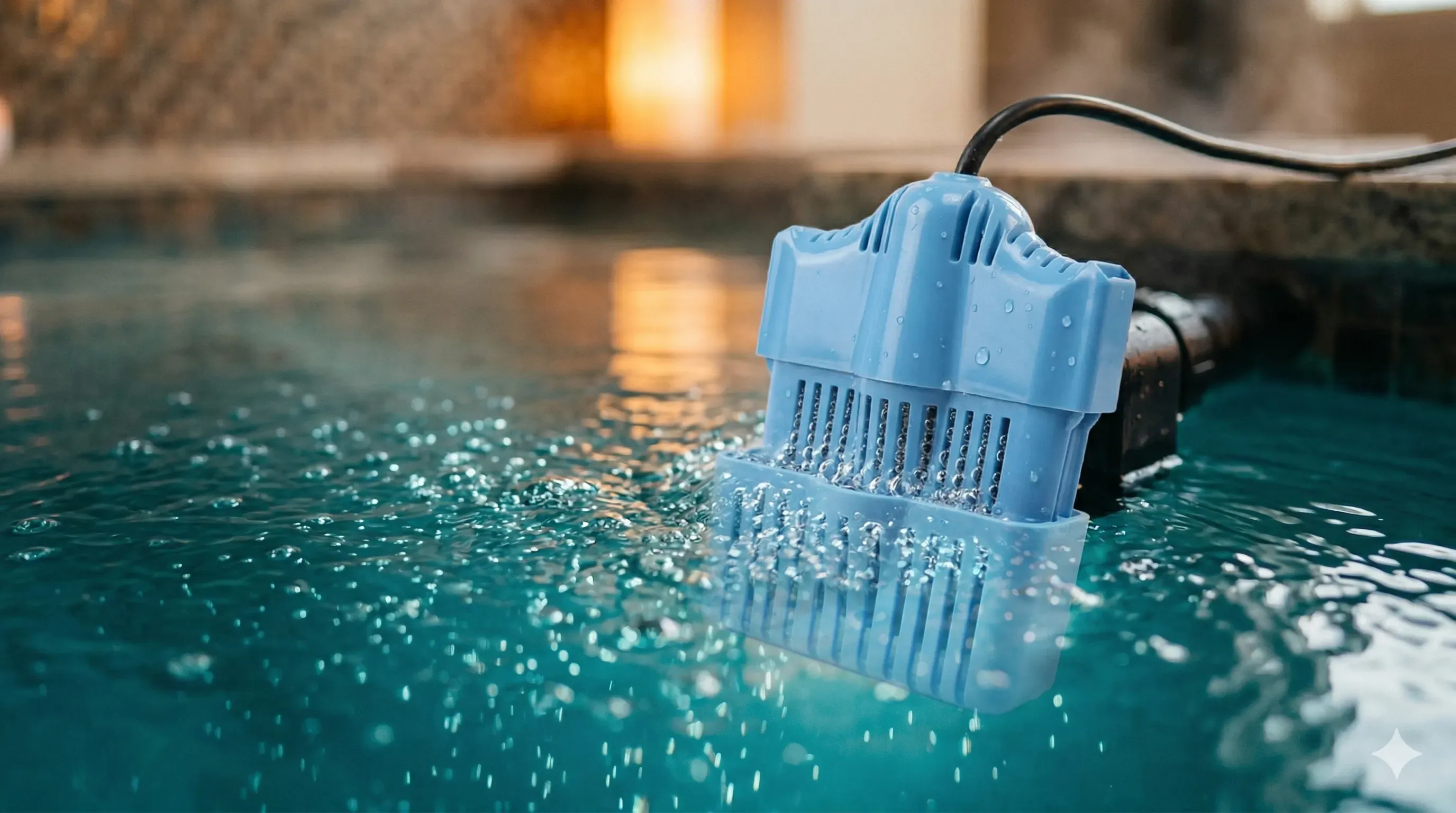
Then there’s filtration. Calling the filter in an inflatable tub a “filter” is generous. It’s a small cartridge powered by a single pump that handles both heating and circulation. Permanent spas have dedicated circulation pumps running 24/7 plus larger pleated filters. Your inflatable filter catches less debris, which means more contaminants stay in the water and your sanitizer picks up the slack. And unlike permanent spas, there’s no ozonator, UV lamp, or mineral cartridge backing it up. Your chlorine or bromine is doing 100% of the bacteria killing. If it drops to zero, nothing else is keeping the water safe.
All of this adds up to faster drain cycles. Where a permanent spa can go 3 to 4 months between water changes, most inflatable tubs need fresh water every 3 to 6 weeks with regular use.
Your tub’s exact volume (look it up before dosing)
Every dosing decision depends on knowing your actual water volume. “About 200 gallons” is not specific enough when a quarter teaspoon makes the difference between balanced and overdosed.
Intex PureSpa models:
| Model | Persons | Water Volume |
|---|---|---|
| Bubble Massage / Greywood Deluxe (77” round) | 4 | 210 gallons |
| Bubble Massage / Greywood Deluxe (85” round) | 6 | 290 gallons |
Bestway / Coleman SaluSpa models:
| Model | Persons | Water Volume |
|---|---|---|
| Miami / Cancun | 2 to 4 | 177 gallons |
| Hawaii / Atlantis (square) | 4 to 6 | 222 gallons |
| Honolulu | 4 to 6 | 242 gallons |
| Helsinki | 5 to 7 | 297 gallons |
| St. Moritz / Napa | 5 to 7 | 314 gallons |
Those numbers assume you fill to the 80% line like the manual suggests. If your model isn’t listed, check the spec page in your manual.
The chemicals you need
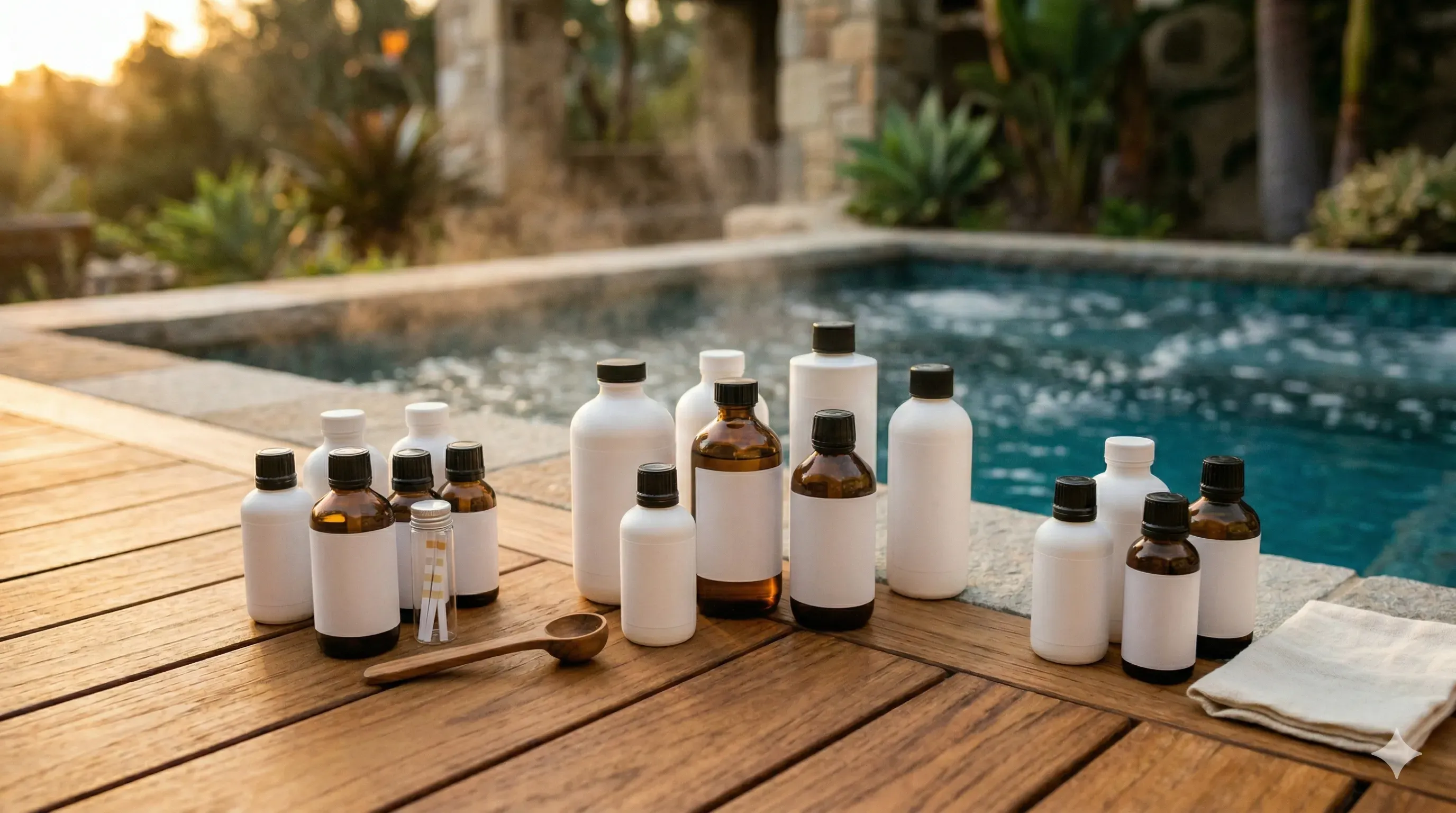
The chemical categories are the same as any hot tub. The difference is dosing amounts and some material-specific rules.
Sanitizer: chlorine or bromine
For chlorine, use dichlor granules (sodium dichloro-s-triazinetrione). Dissolves fast, near-neutral pH, and safe for vinyl. Dose about half a teaspoon per 100 gallons to raise free chlorine by roughly 5 ppm. Target 1 to 3 ppm. Never exceed 5 ppm for extended periods in a vinyl tub.
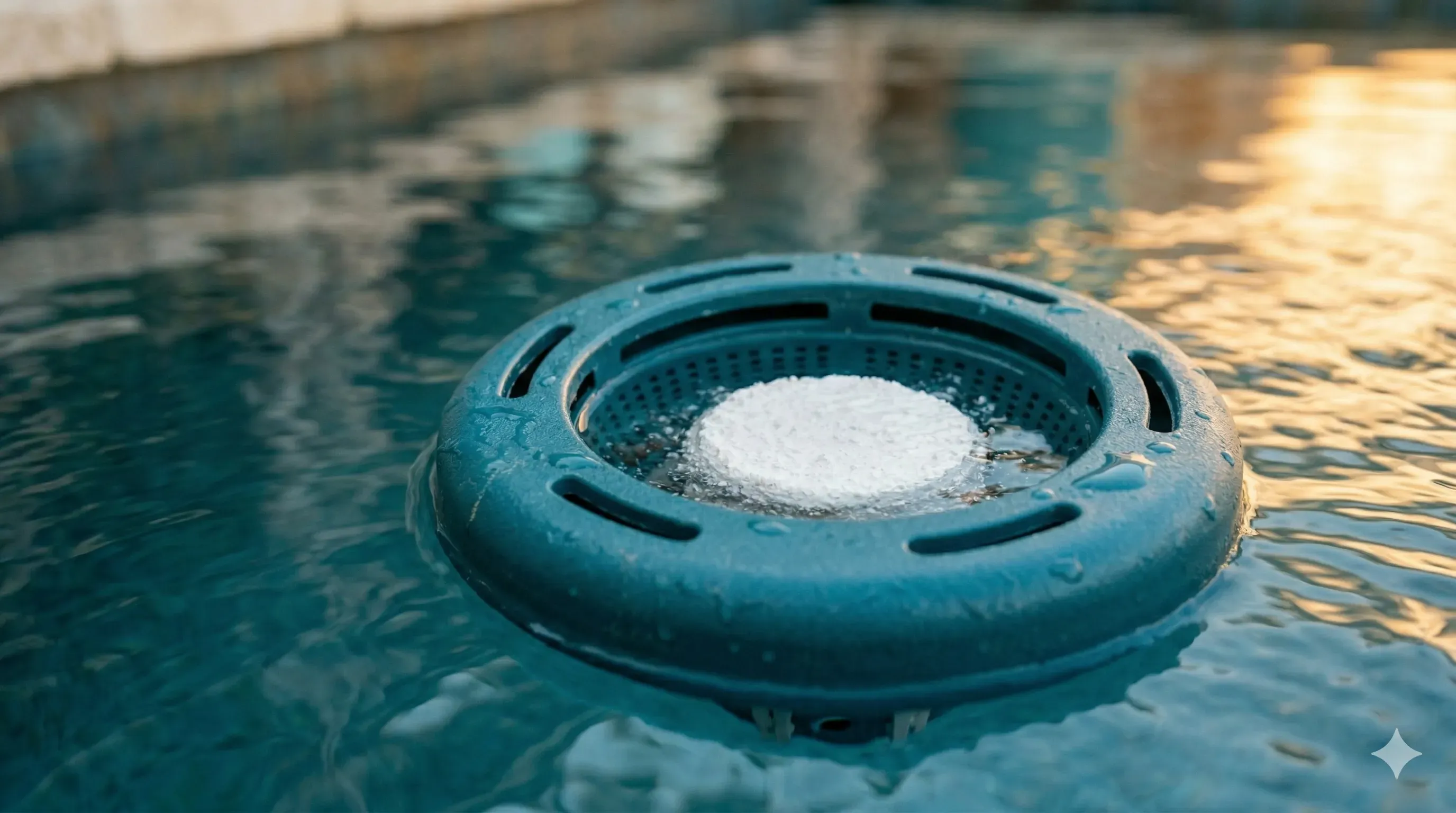
For bromine, use 1-inch tablets in a floating dispenser. Start with 2 to 3 tablets and adjust the dispenser’s flow control based on test results. Target 3 to 5 ppm.
Intex owners: stick with chlorine. Intex’s official maintenance page recommends chlorine and warns that bromine can cause black flaking from the heat exchanger assembly. Multiple forum reports confirm this. If you own an Intex PureSpa, use dichlor granules or the dichlor/bleach method. Bestway and Coleman models are compatible with either sanitizer.
Never use 3-inch trichlor tablets. These are pool chlorine. They have a pH of 2.8, dissolve too slowly, dump massive amounts of cyanuric acid into a small volume, and can bleach your vinyl liner on contact. Use only 1-inch tablets or granules.
pH decreaser (sodium bisulfate): Start with 1 tablespoon per 200 gallons. In small tubs, less is always better. You can add more, but you can’t take it back. Target pH 7.4 to 7.6.
pH increaser (sodium carbonate): 1 teaspoon per 200 gallons for gentle corrections. You’ll rarely need this because inflatable tubs push pH upward through jet aeration, just like permanent spas.
Alkalinity increaser (sodium bicarbonate / baking soda): Add in small increments, circulate 30 minutes between doses, and retest before adding more. Alkalinity raises fast in small volumes. Overshooting forces a full drain to correct. Target 80 to 120 ppm.
Non-chlorine shock (MPS / potassium monopersulfate): About 2 tablespoons per 200 gallons, once a week. Think of it as a deep clean for the water. It breaks down the body oils and organic gunk that sanitizer alone won’t touch.
Defoamer: More important for inflatable tubs than permanent ones. The bubble jets agitate the water heavily, and body oils, lotions, and detergent residue in swimwear create persistent foam in small volumes. Keep a bottle on hand. The real fix is showering before soaking, but a squirt of defoamer clears foam in seconds while you work on preventing it.
First fill: the startup sequence
- Fill through the filter housing if your model allows it, or directly into the tub
- Heat to at least 80°F before adding chemicals
- Test your source water: pH, alkalinity, calcium hardness, and sanitizer (it should read zero)
- Adjust alkalinity first. Add baking soda in small doses (1 tablespoon per 100 gallons), circulate 30 minutes, retest
- Adjust pH to 7.4 to 7.6
- Add calcium hardness increaser if below 150 ppm (low calcium causes foaming in vinyl tubs)
- Add sanitizer last. For chlorine: about 1 teaspoon of dichlor for a 200 gallon tub. For bromine: add sodium bromide (0.5 oz per 100 gallons) to build the bromide reserve, then load the floating dispenser
- Run the pump for 30 minutes to distribute
Test again the next day. Your first pass rarely nails everything because the chemicals interact with each other and with whatever minerals were in your fill water.
Dosing chart for common inflatable tub sizes
These are starting-point doses. Always test first, dose, wait 20 minutes, then retest.
| Chemical | 177 gal (Miami) | 210 gal (Intex 4P) | 290 gal (Intex 6P) |
|---|---|---|---|
| Dichlor (routine) | 3/4 tsp | 1 tsp | 1.5 tsp |
| Dichlor (shock dose) | 1.5 tsp | 2 tsp | 3 tsp |
| pH decreaser | 1 tbsp | 1 tbsp | 1.5 tbsp |
| Baking soda | 1.5 tbsp | 2 tbsp | 3 tbsp |
| MPS shock | 1.5 tbsp | 2 tbsp | 3 tbsp |
These are approximate. Your actual dose depends on your current reading and your target. A pool calculator app can help you get exact amounts based on your specific volume and current ppm.
The filter problem
Your inflatable tub’s filter is the weakest link in the system. Intex uses the Type S1 cartridge. Bestway and Coleman use the Type VI. They’re small, they clog fast, and they don’t last long.
Cleaning schedule:
- Rinse after every use (or at least every 2 to 3 days)
- Deep spray-clean weekly
- Replace every 4 to 6 weeks with regular use (3 to 4 soaks per week)
- Replace immediately if the material is torn, cracked, or permanently discolored
Why this matters for chemistry: A dirty filter reduces water circulation, which means chemicals don’t distribute evenly and debris stays in the water longer. If your sanitizer keeps dropping to zero and you can’t figure out why, check the filter first. A clogged filter forces your sanitizer to work overtime compensating for what the filter should be catching.
Keep spare filters on hand. Running out of filters is more urgent than running out of chlorine because at least chlorine is doing something. A saturated filter is doing nothing.
When to drain and refill
The standard formula: (gallons / number of bathers) / 3 = days between water changes.
Real examples:
- 177 gallon Coleman Miami, 2 regular bathers: (177 / 2) / 3 = 30 days
- 210 gallon Intex 4-person, 2 bathers: (210 / 2) / 3 = 35 days
- 210 gallon Intex 4-person, 4 bathers: (210 / 4) / 3 = 18 days
- 290 gallon Intex 6-person, 3 bathers: (290 / 3) / 3 = 32 days
Don’t set a calendar alarm for day 30. Watch the water instead. Signs you need to drain regardless of the calendar: water that won’t clear up despite balanced chemistry, persistent foam that defoamer can’t fix, a chemical smell that shocking doesn’t resolve, or sanitizer that disappears within hours of adding it.
Draining an inflatable tub takes 30 to 60 minutes depending on the model. Refilling and rebalancing takes a few hours but resets everything. Fresh water is the simplest fix there is.
The dichlor/bleach method for small tubs
The dichlor/bleach method is especially relevant for inflatable tubs because CYA buildup is the fastest chemistry problem in small volumes.
Dichlor is about 50% cyanuric acid by weight. In a 200 gallon tub dosed four times a week, CYA can reach 50 ppm in three to four weeks. At that level, chlorine takes four to five times longer to kill Pseudomonas aeruginosa, the bacteria that causes hot tub rash.
So use dichlor only for the first week or two, until CYA reaches about 20 to 30 ppm. Then switch to plain unscented household bleach (6% to 8.25% sodium hypochlorite) for all ongoing dosing. Bleach adds zero CYA. Your chlorine stays effective, and you avoid the CYA trap that catches most inflatable tub owners within the first month.
For a 200 gallon tub, about 1 to 2 ounces of bleach after each soak maintains free chlorine in the 3 to 5 ppm range. Test before and after to dial in your exact amount.
Common mistakes with inflatable tubs
Using full-size hot tub doses. The dosing on most chemical labels is calculated for 400 to 500 gallon spas. A 177 gallon Coleman Miami is less than half that volume. Always recalculate for your actual gallons, or you’ll overshoot everything.
A surprising number of inflatable owners just drain every few days instead of maintaining chemistry. It sounds logical, but bacteria multiply invisibly. Clear, odorless water at 100°F can harbor dangerous levels of Pseudomonas (the bacteria behind hot tub rash) or Legionella within 48 hours without sanitizer. That’s how people get sick. Plus, reheating from cold every few days runs up your electricity bill fast.
Ignoring the filter. In a permanent spa with a large pleated filter and a 24/7 circulation pump, you can get away with weekly filter rinses. In an inflatable tub, a dirty filter degrades water quality within days. Clean it after every use during heavy use periods.
Floating dispensers are trickier than they look in small tubs. Even at the lowest flow setting, a dispenser with bromine or chlorine tablets can over-sanitize a 177 gallon tub. Start with 1 to 2 tablets and the vents nearly closed. Remove the dispenser between soaks if readings consistently run high. For the most precise control, skip the floater entirely and dose with granules after each soak.
One more thing people miss: turning off the heater between uses to save electricity sounds smart, but it creates a warm, stagnant environment that’s ideal for bacterial growth. Either maintain sanitizer levels and run the pump daily even when not soaking, or drain the tub if you won’t use it for more than a few days.
A realistic weekly routine
Once everything’s balanced, the weekly routine is shorter than most people expect:
Before each soak:
- Quick test strip dip for pH and sanitizer
- Dose if needed, wait 15 minutes, then soak
After each soak:
- Add sanitizer (dichlor or bleach) to replenish what bathers consumed
- Replace the cover immediately
Every 2 to 3 days:
- Rinse the filter
- Check the floating dispenser if using one
Once a week (10 minutes):
- Shock with MPS or a larger dose of sanitizer
- Full test: pH, alkalinity, sanitizer
- Wipe down the waterline
- Deep clean or swap the filter
Monthly:
- Test calcium hardness
- Assess water clarity and foam. If the tub needs a water change, do it
Total time: about 20 to 25 minutes per week, spread across short check-ins. The first two weeks involve more testing as you learn your water’s patterns. After that, it becomes routine.
Frequently asked questions
Do inflatable hot tubs need different chemicals than regular hot tubs? Same chemical types, different doses. You need a sanitizer, pH adjusters, alkalinity increaser, and shock just like any spa. But inflatable tubs hold 150 to 300 gallons instead of 400 to 500, so every dose is smaller. You also need to test more often because small volumes change faster.
How much chlorine do I put in an inflatable hot tub? About half a teaspoon of dichlor granules per 100 gallons for routine dosing. For a 210 gallon tub, that’s roughly one teaspoon. Always test first and add based on your actual reading. Target 1 to 3 ppm free chlorine.
Is bromine or chlorine better for an inflatable hot tub? Both work, but Intex specifically warns against bromine in their tubs because it can corrode the heat exchanger assembly. If you own an Intex, stick with chlorine. Bestway and Coleman models are compatible with either. Bromine stays effective longer in hot water but requires a floating dispenser and sodium bromide to get started.
How often should I change the water in an inflatable hot tub? Every 3 to 6 weeks with regular use. The formula: your tub’s gallons divided by 3, divided by the number of regular bathers. A 200 gallon tub used by 2 people works out to about every 33 days. Draining more often than a permanent spa is normal for inflatables.
Why does my inflatable hot tub use so much chlorine? Small water volume means less sanitizer reserve, there’s no ozone or UV backup sharing the workload, and weak filtration leaves more organic matter for chlorine to burn through. On top of that, hot water degrades chlorine about twice as fast as pool-temperature water.
Can I use 3-inch chlorine tablets in my inflatable hot tub? No. Three-inch tablets are trichlor, designed for pools. In a small inflatable, one tablet will crash your pH, spike CYA dangerously fast, and can bleach or damage the vinyl. Use 1-inch tablets or dichlor granules. For the difference between chlorine types, see our dichlor vs trichlor guide.